VMware 2v0-33-22 practice test
VMware Cloud Professional
Question 1
A cloud administrator is managing a container environment. The application team has complained
that they need to manually restart containers in the event of a failure.
Which solution can the administrator implement to solve this issue?
- A. Kubernetes
- B. VMware vSphere High Availability
- C. VMware vSphere Fault Tolerance
- D. Prometheus
Answer:
A
Explanation:
Kubernetes is an open-source container orchestration system that provides automated deployment,
scaling, and management of containers. It can be used to set up an automated restart policy for
containers in the event of a failure, ensuring that containers are automatically restarted when they
fail.
https://www.vmware.com/pdf/stagemanager1_Users_Guide.pdf
VMware Stage Manager User's Guide
https://www.vmware.com/pdf/stagemanager1_Users_Guide.pdf
Question 2
What is the purpose of the VMware Cloud on AWS Compute Gateway (CGW)?
- A. A Tier-1 router that handles routing and firewalling for the VMware vCenter Server and other management appliances running in the software-defined data center (SDDC)
- B. A Tier-1 router that handles workload traffic that is connected to routed compute network segments
- C. A Tier-0 router that handles routing and firewalling for the VMware vCenter Server and other management appliances running in the software-defined data center (SDDC)
- D. A Tier-0 router that handles workload traffic that is connected to routed compute network segments
Answer:
B
Explanation:
Compute Gateway (CGW) The CGW is a Tier 1 router that handles network traffic for workload VMs
connected to routed compute network segments. Compute gateway firewall rules, along with NAT
rules, run on the Tier 0 router. In the default configuration, these rules block all traffic to and from
compute network segments (see Configure Compute Gateway Networking and Security).
https://docs.vmware.com/en/VMware-Cloud-on-AWS/services/vmc-on-aws-networking-security.pdf
The CGW is a Tier 1 router that handles network traffic for workload VMs connected to routed
compute network segments. Compute gateway firewall rules, along with NAT rules, run on the Tier 0
router.
Question 3
A cloud administrator is managing a VMware Cloud on AWS environment connected to an on-
premises data center using IPSec VPN connection. The administrator is Informed of performance
issues with applications replicating data between VMware Cloud and the on-premises data center.
The total bandwidth used by this replication is 3.8 Gbps.
What should the administrator do to improve application performance?
- A. Deploy VMware HCX.
- B. Deploy AWS Direct Connect.
- C. Deploy a layer 2 VPN connection.
- D. Contact VMware support to request more bandwidth for IPSec VPN connection.
Answer:
B
Explanation:
AWS Direct Connect is a service that establishes a dedicated network connection between an on-
premises data center and an AWS region.
This can improve network performance, reduce costs, and
increase security for applications that require high bandwidth and low latency1
.
A layer 2 VPN connection would not improve performance as it still relies on the public internet.
VMware HCX is a service that simplifies workload migration and mobility between different clouds,
but it does not address network performance issues.
Contacting VMware support to request more
bandwidth for IPSec VPN connection is unlikely to be effective as IPSec VPN has inherent limitations
such as encryption overhead and packet fragmentation
Question 4
With which solution is the cloud administrator interfacing when defining storage policies in a
VMware Cloud software-defined data center (SDDC)?
- A. VMware Virtual Volumes (vVols)
- B. VMware vSAN
- C. iSCSI
- D. VMware Virtual Machine File System (VMFS)
Answer:
B
Explanation:
VMware vSAN is a distributed storage platform that is integrated into the VMware Cloud software-
defined data center (SDDC). It provides policy-based storage management, allowing cloud
administrators to define storage policies that can be applied to virtual machines and other
workloads. These policies govern how data is stored, replicated, and secured, and are used to ensure
that data is stored in a consistent and compliant manner.
https://docs.vmware.com/en/VMware-Cloud-on-AWS/services/com.vmware.vsphere.vmc-aws-manage-data-center-vms.doc/GUID-EDBB551B-51B0-421B-9C44-6ECB66ED660B.html
Question 5
When configuring Hybrid Linked Mode, what is the maximum supported latency between an on-
premises environment and a VMware Cloud on AWS software-defined data center (SDDC)?
- A. 200 milliseconds round trip
- B. 250 milliseconds round trip
- C. 150 milliseconds round trip
- D. 100 milliseconds round trip
Answer:
D
Explanation:
Hybrid Linked Mode can tolerate a time skew of up to ten minutes between the on-premises data
center and the cloud SDDC. The maximum latency between your cloud SDDC and on-premises data
center cannot exceed 100 msec roundtrip.
https://docs.vmware.com/en/VMware-Cloud-on-AWS/services/com.vmware.vsphere.vmc-aws-manage-data-center-vms.doc/GUID-BE75F0F1-2864-4926-97FE-37E635471C43.html
Question 6
A cloud administrator is In the process of troubleshooting a non-compliant object. How can the
administrator change a VM storage policy for an ISO image?
- A. Modify the default VM storage policy and recreate the ISO image.
- B. Modify the default VM storage policy.
- C. Apply a new VM storage policy.
- D. Attach the ISO Image to a virtual machine.
Answer:
C
Explanation:
To address a non-compliant object, such as an ISO image, a cloud administrator can apply a new VM
storage policy directly to that object. This doesn't require modifying the default VM storage policy or
recreating the ISO image. Applying a new policy to the ISO allows for specific storage requirements to
be met without affecting other objects or the default settings.
Question 7
Which four steps must a cloud administrator take to deploy a new private cloud In Azure VMware
Solution? (Choose four.)
- A. Identify the maximum number of hosts needed for future capacity.
- B. Identify the desired availability zone.
- C. Identify a management CIDR of size /22.
- D. Open a support request with Microsoft Azure requesting capacity.
- E. Identify a management CIDR of size /20.
- F. Identify the desired region.
- G. Identify the current number of hosts needed.
Answer:
CDFG
Explanation:
Planning your Azure VMware Solution deployment is critical for a successful production-ready
environment for creating virtual machines (VMs) and migration. During the planning process, you'll
identify and gather what's needed for your deployment. As you plan, make sure to document the
information you gather for easy reference during the deployment. A successful deployment results in
a production-ready environment for creating virtual machines (VMs) and migration.
In this how-to article, you'll do the following tasks:
Identify the Azure subscription, resource group, region, and resource name
Identify the size hosts and determine the number of clusters and hosts
Request a host quota for eligible Azure plan
Identify the /22 CIDR IP segment for private cloud management
Identify a single network segment
Define the virtual network gateway
Define VMware HCX network segments
Question 8
Which three functions are provided by the components within the Kubernetes control plane?
(Choose three.)
- A. Balances pods across the nodes within a Kubernetes cluster.
- B. Ensures that containers are running in a pod.
- C. Configures network rules to route traffic to containers within the Kubernetes cluster.
- D. Stores Kubernetes cluster data in a key-value data store.
- E. Watches the API for changes and responds with appropriate actions.
- F. Stores and distributes container images.
Answer:
ADE
Explanation:
https://kubernetes.io/docs/concepts/overview/components/#control-plane-components
https://kubernetes.io/docs/concepts/overview/components/
Question 9
Which Tanzu Kubernetes Grid component is used to create, scale, upgrade and delete workload
clusters?
- A. Tanzu Kubernetes cluster
- B. Tanzu CLI
- C. Tanzu Supervisor cluster
- D. Tanzu Kubernetes Grid extensions
Answer:
B
Explanation:
https://docs.vmware.com/en/VMware-vSphere/7.0/vmware-vsphere-with-tanzu/GUID-4D0D375F-C001-4F1D-AAB1-1789C5577A94.html
Tanzu CLI is a command-line interface used to create, scale, upgrade, and delete workload clusters
that are part of the Tanzu Kubernetes Grid
[1]
. Tanzu CLI also allows you to manage the components
of the Tanzu Kubernetes Grid
[1]
, such as the Tanzu Kubernetes cluster and the Tanzu Supervisor
cluster. It also provides access to the Tanzu Kubernetes Grid extensions
[1]
, which allow you to
extend the functionality of the Tanzu Kubernetes cluster.
https://docs.vmware.com/en/VMware-Tanzu-CLI/index.html
Question 10
A cloud administrator wants to migrate a virtual machine using VMware vSphere vMotlon from their
on-premises data center to their VMware Cloud on AWS software-defined data center (SDDC), using
an existing private line to the cloud SDDC.
Which two requirements must be met before the migration can occur? (Choose two.)
- A. The versions of VMware vSphere need to match between the on-premises data center and the cloud SDDC.
- B. A Layer 2 connection is configured between the on-premises data center and the cloud SDDC.
- C. AWS Direct Connect is configured between the on-premises data center and the cloud SDDC.
- D. IPsec VPN is configured between the on-premises data center and the cloud SDDC.
- E. Cluster-level Enhanced vMotion Compatibility (EVC) is configured in the on-premises data center and the cloud SDDC.
Answer:
BC
Explanation:
For migrating a virtual machine using VMware vSphere vMotion from an on-premises data center to
VMware Cloud on AWS SDDC, specific network requirements must be met. A Layer 2 connection (B)
ensures that VMs can retain the same IP address and network settings post-migration, facilitating
seamless migration without the need for reconfiguration. AWS Direct Connect (C) establishes a
dedicated network connection between the on-premises data center and AWS, providing a more
reliable and consistent network experience compared to internet-based connections. This setup is
crucial for high-bandwidth, low-latency connections required by vMotion to efficiently transfer VM
memory and state information during migration.
Question 11
A company needs to Increase its Infrastructure capacity quickly to accommodate their rapid business
growth. Which cloud use case describes their requirement?
- A. Maintain and Modernize
- B. Consolidate and Migrate
- C. Disaster Recovery
- D. Maintain and Expand
Answer:
D
Explanation:
The cloud use case that describes the requirement of increasing the infrastructure capacity quickly
to accommodate the rapid business growth is Maintain and Expand1
.
This use case is suitable for
organizations that want to leverage the cloud to scale their existing data center capacity on demand,
without changing their existing applications or processes1
.
VMware Cloud on AWS enables this use
case by providing a consistent and compatible cloud platform that can be integrated with the on-
premises VMware environment1
.
VMware Cloud on AWS allows customers to add or remove hosts
from their SDDC cluster in minutes, using the Elastic DRS feature2
.
Customers can also use the
VMware HCX service to migrate workloads between on-premises and cloud SDDCs seamlessly and
securely3. Reference: 1: Use Cases for VMware Cloud on AWS, 2: Manage Elasticity in SDDC Clusters -
VMware Docs, 3
: Migrate Workloads Using VMware HCX - VMware Docs
Question 12
Which out-of-the-box role is required in order to create a content library In VMware Cloud on AWS?
- A. CloudGlobalAdmln
- B. CloudAdmin
- C. Active Directory ESXi Admin
- D. Ad mlnistrator@vSphere. local
Answer:
B
Explanation:
The CloudAdmin role has the privileges necessary to create and manage SDDC workloads and related
objects such as storage policies, content libraries, vSphere tags, and resource pools
The CloudAdmin role has the following privileges in SDDC Version 1.18.
ContentLibrary.AddCertToTrustStore
ContentLibrary.AddLibraryItem
ContentLibrary.CheckInTemplate
ContentLibrary.CheckOutTemplate
ContentLibrary.CreateLocalLibrary
ContentLibrary.CreateSubscribedLibrary
ContentLibrary.DeleteCertFromTrustStore
ContentLibrary.DeleteLibraryItem
ContentLibrary.DeleteLocalLibrary
ContentLibrary.DeleteSubscribedLibrary
ContentLibrary.DownloadSession
ContentLibrary.EvictLibraryItem
ContentLibrary.EvictSubscribedLibrary
ContentLibrary.GetConfiguration
ContentLibrary.ImportStorage
ContentLibrary.ProbeSubscription
ContentLibrary.ReadStorage
ContentLibrary.SyncLibrary
ContentLibrary.SyncLibraryItem
ContentLibrary.TypeIntrospection
ContentLibrary.UpdateConfiguration
ContentLibrary.UpdateLibrary
ContentLibrary.UpdateLibraryItem
ContentLibrary.UpdateLocalLibrary
ContentLibrary.UpdateSession
ContentLibrary.UpdateSubscribedLibrary
https://docs.vmware.com/en/VMware-Cloud-on-AWS/services/com.vmware.vsphere.vmc-aws-manage-data-center-vms.doc/GUID-DFB3C048-5728-4DE9-9380-7240748875C3.html
Question 13
What is one way in which VMware Multi-Cloud addresses challenges with the cloud computing
model?
- A. Provides savings on capital expenses and the use of a flexible payment structure where payment Is only done based on the resources used.
- B. Provides visibility and tools to manage resources, workloads and operations across clouds from a common operating environment.
- C. Eliminates worry associated with managing IT infrastructures and shifts focus to application development and other priorities using the most up-to-date technology.
- D. Increases agility that encompasses scalability, customizability, and access to the cloud service from anywhere and on any device.
Answer:
B
Explanation:
https://www.vmware.com/topics/glossary/content/multi-cloud.html
VMware Multi-Cloud provides visibility and tools to manage resources, workloads and operations
across clouds from a common operating environment. This eliminates the need to manage multiple
cloud environments in different clouds and provides a unified view of all cloud resources and
applications. This makes it easier to monitor and manage workloads across clouds, reducing
complexity and increasing agility. VMware Multi-Cloud also provides powerful automation and
orchestration capabilities to help streamline operations and improve efficiency. [1]
[1]
https://www.vmware.com/products/vmware-multi-cloud.html
Question 14
A customer is looking to leverage a VMware Public Cloud solution to provide them with additional
compute capacity as seasonal demand increases for their online business.
The current on-premises data center is configured as follows:
• VMware vSphere 7.0
• VMware vSphere Distributed Switch (vDS) 7.0
• Management and Server network - 172.18.0.0/16
• vMotion network - 192.168.120.0/24
• 250 application servers
Given the information in the scenario, which capability of VMware HCX will the customer not be able
to utilize?
- A. Cold migration
- B. Layer 2 extension
- C. Bulk migration
- D. WAN optimization
Answer:
B
Explanation:
According to the VMware official guide, VMware Tanzu Service Mesh is a cloud-native service mesh
platform that simplifies the secure communication between microservices running in Kubernetes
clusters . It provides secure and consistent network communication between services and enables
policy-driven authorization and observability. With its distributed tracing capabilities, Tanzu Service
Mesh can help administrators easily monitor and troubleshoot their applications. It also provides a
unified platform to manage the lifecycle of Tanzu Kubernetes clusters, including provisioning,
upgrades, patching, and more.
Management “and Server” network - 172.18.0.0/16
“and Server” being the 250 application servers.
https://docs.vmware.com/en/VMware-HCX/4.6/hcx-user-guide/GUID-DBDB4D1B-60B6-4D16-936B-4AC632606909.html
Detected and Restricted Source Network Types
The HCX Network Extension service detects and prevents several non-supported Network Extension
scenarios (items are dimmed in the Network Extension UI):
• vSphere infrastructure networks (ESXi VMkernel networks).
Question 15
Refer to the exhibit.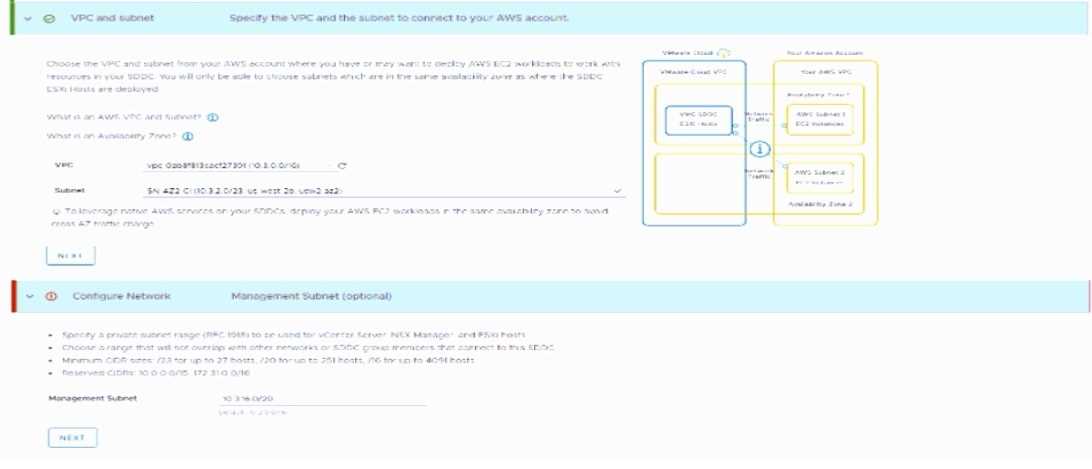
A cloud administrator is deploying a new VMware Cloud on AWS virtual private cloud (VPC). After
clicking on deploy, the screen refreshes and displays the information that is provided in the exhibit.
What is the issue with the management CIDR that is causing the deployment to fall?
- A. It overlaps with the AWS subnet.
- B. It overlaps with the AWS VPC CIDR.
- C. It is part of the reserved CIDRs.
- D. It is an invalid size.
Answer:
A
Explanation:
https://docs.aws.amazon.com/whitepapers/latest/sddc-deployment-and-best-practices/deploying-vmware-cloud-on-aws-sddc.html
This must be a RFC1918 private address space (10.0.0.0/8,
172.16.0.0/12, or 192.168.0.0/16) with CIDR block sizes of /16, /20, or /23. The management CIDR
block cannot be changed after the SDDC is deployed. Choose a range of IP addresses that does not
overlap with the AWS subnet you are connecting to. If you plan to connect the SDDC to an on-
premises DC or another environment, the IP subnet must be unique within your enterprise network
infrastructure. Choose a CIDR that will give you future scalability.