sas a00-280 practice test
SAS Certified Clinical Trials Programmer Using SAS 9
Question 1
Given the following data at WORK DEMO: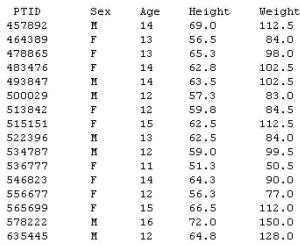
Which SAS program prints only the first 5 males in this order from the data set?
A.
proc sort data=WORK.DEMO out=out;
by sex;
run;
proc print data= out (obs=5);
run;
B.
proc print data=WORK.DEMO(obs=5);
where Sex='M';
run;
C.
proc print data=WORK.DEMO(where=(sex='M'));
where obs<=5;
run;
D.
proc sort data=WORK.DEMO out=out;
by sex descending;
run;
proc print data= out (obs=5);
run;
Answer:
B
Question 2
Which SAS program will apply the data set label 'Demographics' to the data set named DEMO?
A.
data demo (label='Demographics');
set demo;
run;
B.
data demo;
set demo (label='Demographics');
run;
C.
data demo (label 'Demographics');
set demo;
run;
D.
data demo;
set demo;
label demo= 'Demographics';
run;
Answer:
A
Question 3
The following SAS program is submitted:
proc sort data=SASUSER.VISIT out=PSORT;
by code descending date cost;
run;
Which statement is true regarding the submitted program?
- A. The descending option applies to the variable CODE.
- B. The variable CODE is sorted by ascending order.
- C. The PSORT data set is stored in the SASUSER library.
- D. The descending option applies to the DATE and COST variables.
Answer:
B
Question 4
What information can be found in the SAS Dictionary tables? (Choose two.)
- A. datasets contained within a specified library
- B. values contained within a specified format
- C. variables contained within a specified dataset
- D. values contained within a specified variable
Answer:
A, C
Question 5
Given the following data set:
Which program was used to prepare the data for this PROC PRINT output?
A.
proc sort data=one out=two;
by subjid;
run;
B.
proc sort data=one out=two nodupkey;
by subjid;
run;
C.
proc sort data=one out=two nodup;
by subjid;
run;
D.
proc sort data=one out=two nodupkey;
by subjid trt;
run;
Answer:
B
Question 6
This question will ask you to provide a line of missing code.
The following SAS program is submitted: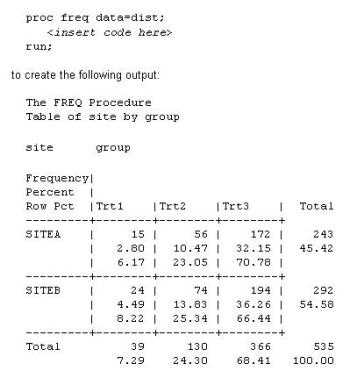
Which statement is required to produce this output?
- A. TABLES site*group /nocol;
- B. TABLES site*group /norow;
- C. TABLES site*group;
- D. TABLES site*group /nocol norow;D. TABLES site*group /nocol norow;
Answer:
A
Question 7
Which statement correctly adds a label to the data set?
A.
DATA two Label="Subjects having duplicate observations";
set one;
run;
B.
DATA two;
Label="Subjects having duplicate observations";
set one;
run;
C.
DATA two;
set one;
Label dataset="Subjects having duplicate observations";
run;
D.
DATA two(Label="Subjects having duplicate observations");
set one;
run;
Answer:
D
Question 8
Given the following data set: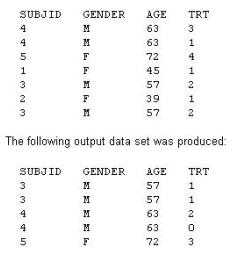
Which SAS program produced this output?
A.
proc sort data=one(where=(age>50)) out=two;
by subjid;
run;
B.
proc sort data=one(if=(age>50)) out=two;
by subjid;
run;
C.
proc sort data=one out=two;
where=(age>50);
by subjid;
run;
D.
proc sort data=one out=two;
if age>50;
by subjid;
run;
Answer:
A
Question 9
CORRECT TEXT
The following question will ask you to provide a line of missing code.
The following program is submitted to output observations from data set ONE that have more than
one record per patient.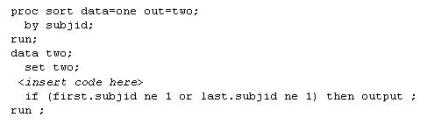
In the space below, enter the line of code that will correctly complete the program (Case is ignored.
Do not add leading or trailing spaces to your answer.).
Answer:
BYSUBJID;
BYSUBJID;
Question 10
Given the data set WORK.BP with the following variable list: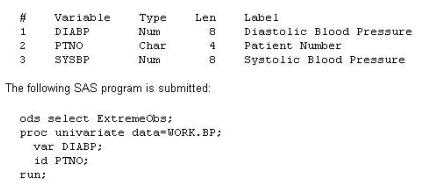
Which output will be created by the program?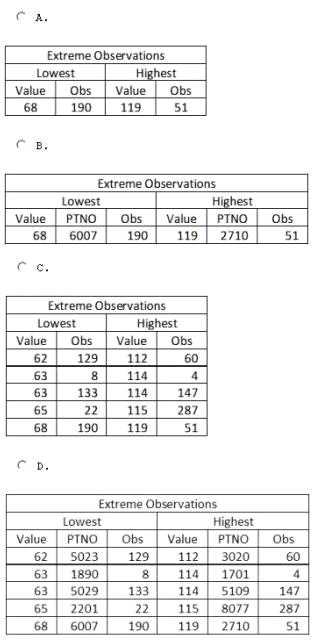
- A. Option A
- B. Option B
- C. Option C
- D. Option D
Answer:
D
Question 11
The following SAS program is submitted: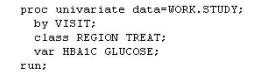
You want to store all calculated means and standard deviations in one SAS data set.
Which statement must be added to the program?
- A. output mean std;
- B. ods output mean=m1 m2 std=s1 s2;
- C. output out=WORK.RESULTS mean=m1 m2 std=s1 s2;
- D. ods output out=WORK.RESULTS mean=m1 m2 std=s1 s2;
Answer:
C
Question 12
Which program will report all created output objects in the log?
A.
proc ttest data=WORK.DATA1 ods=trace;
class TREAT;
var RESULTS;
run;
B.
ods trace on;
proc ttest data=WORK.DATA1;
class TREAT;
var RESULTS;
run;
C.
ods trace=log;
proc ttest data=WORK.DATA1;
class TREAT;
var RESULTS;
run;
D.
ods trace log;
proc ttest data=WORK.DATA1;
class TREAT;
var RESULTS;
run;
Answer:
B
Question 13
Review the following procedure format:
What is the required type of data for the variable in this procedure?
- A. Character
- B. Continuous
- C. Categorical
- D. Treatment
Answer:
B
Question 14
The following output is displayed:
Which SAS program created this output?
A.
proc freq data=WORK.TESTDATA;
tables gender * answer / nocol norow nopercent;
run;
B.
proc freq data=WORK.TESTDATA;
tables answer * gender / nocol norow nopercent;
run;
C.
proc freq data=WORK.TESTDATA;
tables gender * answer / nocol norow nopercent missing;
run;
D.
proc freq data=WORK.TESTDATA;
tables answer * gender / nocol norow nopercent missing;
run;
Answer:
A
Question 15
You want 90% confidence limits for a binomial proportion from a one-way table with PROC FREQ.
Which option must you add to the TABLES statement?
- A. BINOMIAL
- B. BINOMIAL ALPHA=0.9
- C. BINOMIAL ALPHA=90
- D. BINOMIAL ALPHA=0.1
Answer:
D