sas a00-260 practice test
SAS Data Integration Development for SAS 9
Question 1
In SAS Data Integration Studio, the SCD Type 2 Loader transformation will do which of the following?
- A. find row matches using the business key
- B. find row matches using generated cluster numbers
- C. find non-standard values using a generated key
- D. find non-standard values using a business key
Answer:
A
Question 2
Assume that a SAS Data Integration Studio job is populating a table, and the table has metadata
definitions for two simple indexes. Which of the following is NOT a valid location for viewing which
columns are indexed?
- A. the Load Technique tab in the Table Loader transformation properties window
- B. the Indexes tab in the table properties window
- C. the Columns tab in the table properties window
- D. the Columns tab in the Details panel of the open job, with the table selected in the job flow
Answer:
A
Question 3
Consider the job flow diagram in the display. Assume the inner job has a parameter defined
specifying a table name. Which statement is FALSE?
- A. The Inner Job can be successfully executed by itself, but only if the defined parameter has been assigned a valid default value.
- B. The Inner Job cannot be successfully executed by itself unless it is disassociated from the loop job.
- C. The Control Table column is mapped to the parameter defined for the Inner Job using the Loop transformation properties window.
- D. If the server that executes the job has multiple CPUs, parallel processing can be enabled in the Loop transformation properties window.
Answer:
B
Question 4
In SAS Data Integration Studio, source table records and dimension table records are combined for
output using which transformation?
- A. Data Validation
- B. Lookup
- C. DataFlux lS Job
- D. Table Loader
Answer:
B
Question 5
The SAS Data Integration Studio SCD Type 2 Loader transformation performs which of the following?
- A. Loads source table records into a standardization table.
- B. Loads dimension table records into a fact table.
- C. Loads source table records into a dimension table.
- D. Loads fact table records into a multi-threaded table.
Answer:
C
Question 6
Select the valid reasons for using SAS Data Integration Studio’s Table Loader transformation. (Choose
two.)
- A. Create and replace permanent tables.
- B. Maintain access privileges to permanent tables.
- C. Apply and maintain constraints on permanent tables.
- D. Delete and remove permanent tables.
Answer:
C, D
Question 7
After creating a stored process from a SAS Data Integration Studio job, how can you test the stored
process to make sure it runs correctly?
- A. Execute the stored process in SAS Data Integration Studio.
- B. Execute the stored process in SAS Management Console.
- C. Execute the stored process using the SAS Add-In for Microsoft Office or SAS Enterprise Guide.
- D. Execute the stored process using SAS Display Manager’s Stored Process Test window.
Answer:
C
Question 8
Within SAS Data Integration Studio, which one of the following is NOT an option available from the
File-> New menu choice under External File grouping?
- A. Delimited
- B. Fixed Width
- C. User Written
- D. COBOL Copybook
Answer:
D
Question 9
In the following display, can status handling be enabled for the Extract transformation?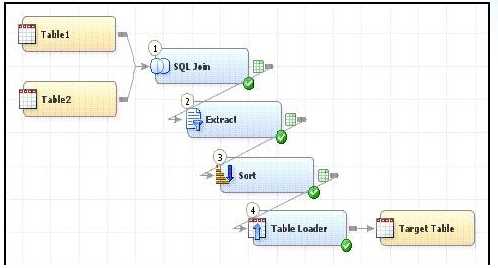
- A. No. The Extract transformation does not have a status handling tab in its Properties window, and the Return Code Check transformation can only provide status handling at the job level.
- B. Yes. The Return Code Check transformation can be added to the END of the job flow - the Status Handling tab in the Return Code Check transformation properties can then establish the desired status handling.
- C. No. The Extract transformation does not have a Status Handling tab in its Properties window, therefore it is not possible to establish status handling for this transformation.
- D. Yes. The Return Code Check transformation can be added to the job flow immediately following the Extract - the Status Handling tab in the Return Code Check transformation properties can then establish the desired status handling.
Answer:
B
Question 10
Assume that SAS Data Integration Studio Table Loader is being used in a job. The load style selected
is Append to Existing. Which statement is true regardingAssume that SAS Data Integration Studio?
Table Loader is being used in a job. The load style selected is Append to Existing. Which statement is
true regarding this load style?
- A. It generates PROC APPEND code.
- B. It generates PROC SQL code.
- C. It generates either PROC SQL code or PROC APPEND code depending on further option choices.
- D. It generates DATA STEP APPEND code.
Answer:
C
Question 11
Which statement is FALSE regarding foreign keys?
- A. A foreign key is one or more columns that are associated with a primary key or unique key in another table.
- B. A table can have zero or more foreign keys.
- C. A foreign key cannot exist without an associated primary or unique key.
- D. A table can have only one foreign key defined.
Answer:
D
Question 12
The purpose of change management in SAS Data Integration Studio is to manage:
- A. metadata objects across metadata servers
- B. metadata objects within a logged on user’s personal folder
- C. metadata objects within a metadata server
- D. metadata objects within a logged on user’s Checkouts Tree
Answer:
C
Question 13
Which action is performed by the Lookup transformation in SAS Data Integration Studio?
- A. combines rows from multiple tables into a single row
- B. combines rows from multiple tables into multiple rows
- C. validates that values are unique
- D. validates that values are not null
Answer:
A
Question 14
In SAS Data Integration Studio, which component allows the definition of job flows with
dependencies between different jobs?
- A. the deployment wizard of SAS Data Integration Studio
- B. the Scheduling Manager plug-in in SAS Management Console
- C. the Scheduling Server
- D. the SAS DATA Step Batch Server
Answer:
B
Question 15
How can you test the interaction of the options of a SAS Data Integration Studio Generated
transformation?
- A. The transformation has to be used within a job to interactively test the options with the Test Prompt button in the Options window from the properties of the transformation within the job editor.
- B. The options can be tested after finalizing and saving the transformation with the Test Prompt item on the Tools menu.
- C. The options can be tested only after adding all options that are assigned to the source code with the Test Prompt button in the Options window of the New Transformation wizard.
- D. The options can be tested at any time after adding them to the transformation with the Test Prompt button in the Options window of the New Transformation wizard.
Answer:
D