pmi pmi-sp practice test
PMI Scheduling Professional Practice Test
Question 1
Once the project's WBS has been created what process may happen next?
- A. Estimate activity resources
- B. Define activities
- C. Estimate activity durations
- D. Sequence activities
Answer:
B
Explanation:
The define activities process is the process that may begin once the project's WBS has been
completed and approved. It is possible, in some projects, to complete the WBS and the activity list at
the same time. Answer option D is incorrect. Sequencing the activities cannot happen until the
activity list has been created. Answer option A is incorrect. Estimating activity resources is
dependent on the activity list, so this choice is not valid. Answer option C is incorrect. Estimate
activity durations are dependent on the activity list, so this choice is not valid.
Question 2
Which of the following scheduling techniques identifies the successor activities and the predecessor
activities to assist the project manager in sequencing the project work?
- A. Precedence Diagramming Method
- B. Schedule network template
- C. Dependency determination
- D. Activity on the Node
Answer:
A
Explanation:
The Precedence Diagramming Method uses both predecessors and successors as nodes in the
project network diagram. The PDM approach is the most common network diagram approach used.
Answer option C is incorrect. Dependency determination identifies the order of the project work.
Answer option B is incorrect. The schedule network template is a tool that uses a previous project
network diagram as a base for the current project network diagram. Answer option D is incorrect.
Activity on the node laces activities on circles within a network diagram. It is an example of the
precedence diagramming method.
Question 3
You are the project manager of the NHGQ project for your company. You must create and distribute
performance reports every week to your key project stakeholders. What communication technique
do you normally use to distribute reports?
- A. Push technique
- B. Many-to-many
- C. One-to-one
- D. Pull technique
Answer:
A
Explanation:
Performance reports are distributed through the push technique. This means that the project
manager distributes the reports regularly through a mechanism, such as email. Answer option C is
incorrect. One-to-one technique describes a conversation between two people. Answer option B is
incorrect. Many-to-many technique describes a conversation between many people. Answer option
D is incorrect. A pull technique describes the recipients of the report "pulling" the information, such
as from a Website.
Question 4
Your project team is executing the project plan and things are going well. Your team has reached its
first milestone and is now in the second phase of the project. The project stakeholders have
requested that you find a method to reduce the duration of the project. They will reward you and
your project team with a 25 percent bonus of the project costs if you can finish the project thirty
days earlier than what was already planned. The stakeholders, however, will not approve any
additional labor costs as part of the agreement. Which approach could you use to shorten the
duration of the project?
- A. Perform resource leveling for the project.
- B. Crash the project schedule.
- C. Fast track the project.
- D. Remove things from the project scope.
Answer:
C
Explanation:
Fast tracking is a technique for compressing project schedule. In fast tracking, phases are overlapped
that would normally be done in
sequence. It is shortening the project schedule without reducing the project scope. It does not add
any additional labor but it can introduce project risks. Answer option D is incorrect. Removing things
from the project scope can reduce the project duration, but it will not satisfy the requirements the
stakeholders have identified. Answer option A is incorrect. Resource leveling can actually increase
the project duration. Answer option B is incorrect. Crashing can reduce the project duration but it
increases the labor expense, something the stakeholders won't approve.
Question 5
The Define Activities process is the first process in the project time management knowledge are
a. The Define Activities process creates just three outputs as a result of decomposition, rolling wave
planning, templates, and expert judgment. Which one of the following is not an output of the Define
Activities process?
- A. Activity list
- B. Milestone list
- C. Activity attributes
- D. Project document updates
Answer:
D
Explanation:
Project document updates are not an output of the Define Activities process. Project document
updates are the outputs for estimate activity resources. Project document updates include the
following: Activity list Activity attributes Resource calendars Answer option A is incorrect. The
activity list is an output of the define activities process. Answer option C is incorrect. The activity
attributes is an output of the define activities process. Answer option B is incorrect. The milestone
list is an output of the define activities process.
Question 6
Examine the figure given below:
If Activity B takes eight days to complete instead of five days as schedule, how long can you now
delay Activity H?
- A. Three days
- B. One day
- C. Four days
- D. Zero days
Answer:
B
Explanation:
Activity B is not on the critical path and it has a total of four days of float. If Activity B takes a total of
eight days, it will consume three days of float. However, the total duration of the path ABEHJ may
not exceed 26 days, as this is the total duration for the project. Although Activity H has a total of
four days of float available, the consumption of three days of float on this path will reduce the total
float for Activity H to just one day. If Activity H is delayed by more than one day, then the project will
be late. Answer option D is incorrect. There is one day of float still available for Activity H. Answer
options A and C are incorrect. These are not the valid answers, as there is just one day of float
available for Activity H.
Question 7
You are the project manager of the GHT Project. Ben, one of your project team members, does not
understand the idea of a milestone. Which of the following best describes what a milestone is?
- A. A significant point in the project
- B. A goal of reaching a significant delivery of project benefits by an identified date
- C. An imposed date for the project to reach a given point
- D. The completion of a project activity that is crucial to project completion
Answer:
A
Explanation:
A milestone is simply a significant point or event in the project. It does not have to be assigned to a
specific date, but is usually assigned to the completion of project phases. A milestone is the end of a
stage that marks the completion of a work package or phase, typically mark d by a high level event
such as completion, endorsement or signing of a deliverable, document or a high level review
meeting. In addition to signaling the completion of a key deliverable, a milestone may also signify an
important decision or the derivation of a critical piece of information, which outlines or affects the
future of a project. In this sense, a milestone not only signifies distance traveled (key stages in a
project) but also indicates direction of travel since key decisions made at milestones may alter the
route through the project plan. To create a milestone, enter 0 (zero) in the Duration field. The task
will automatically be classified as a milestone. Answer option C is incorrect. This is a project
constraint. Answer option B is incorrect. A project goal is an objective for time, cost, scope, and
other metrics. Answer option D is incorrect. All activities must be completed in order to complete
the project work. Activities that are not completed are quality issues that prevent the project from
completing the project scope.
Question 8
You are the project manager of the GHY Project. Management wants you to create a process
improvement plan for your project. Your project will be studied by management and will become a
standard for all future organizational projects based on your project's performance, approach, and
implementation of project processes. All of the following should be included in your project's
process improvement plan except for which one?
- A. Process boundaries
- B. Process configuration
- C. Targets for improved performance
- D. Identification of project risks
Answer:
D
Explanation:
Identification of the project risks is not part of the process improvement plan. Identify risks is a risk
management process, and risks are recorded in the risk register. Answer options A, B, and C are
incorrect. Process boundaries, Process configuration and Targets for improved performance are
parts of the process improvement plan.
Question 9
George is the project manager of the NHQ Project and has a budget of $778,000. The project is
scheduled to last for one year with an equal amount of work completed each quarter. The second
quarter of the project has ended and George has spent $325,000 but has only finished forty percent
of the project. Management needs a variance report for the project schedule. What value should
George report in this instance?
- A. .96
- B. -$77,800
- C. $-34,500
- D. -$13,800
Answer:
B
Explanation:
Schedule variance (SV) is a measure of schedule performance on a project. The variance notifies that
the schedule is ahead or behind what was planned for this period in time. The schedule variance is
calculated based on the following formula: SV = Earned Value (EV) - Planned Value (PV) If the
resulting schedule is negative, it indicates that the project is behind schedule. A value greater than 0
shows that the project is ahead of the planned schedule. A value of 0 indicates that the project is
right on target. The earned value in this instance is forty percent of the project budget, $778,000,
and the planned value is $398,000 because George is to be fifty percent done at the end of the
second quarter, as the work is spread evenly across all quarters. The schedule variance is -$77,800
for the project. Answer option A is incorrect. .96 represents the cost performance index. Answer
option C is incorrect. -$34,500 represents the project's variance at completion if the project
continues as is. Answer option D is incorrect. -$13,800 is the cost variance for the project.
Question 10
You are the project manager of the NHQ Project. Management has set a conformance to the project
schedule for your project at 0.95. What does this term mean?
- A. It means the largest schedule variance you can have is five percent.
- B. It is the earned value divided by the planned value for your project.
- C. It is the expectation of management to be 95 on schedule at 95 percent of the project.
- D. It means you will need to earn at least 95 cents per dollar invested in the project.
Answer:
A
Explanation:
Conformance to schedule is a required adherence for the project's schedule. In this instance, the
project manager must not allow the schedule to slip more than five percent. Answer option B is
incorrect. This is the description of the schedule performance index. Answer option D is incorrect.
This is the description of the cost performance index. Answer option C is incorrect. This is not a valid
statement about the project performance.
Question 11
Which one of the following estimate types is a form of expert judgment?
- A. Parametric estimate
- B. Analogous estimate
- C. Bottom-up estimate
- D. Definitive estimate
Answer:
B
Explanation:
An analogous estimate is a form of expert judgment because it relies on historical information. The
historical information, assuming that it is accurate, serves as the conduit to the expert that created
the historical information. Answer option C is incorrect. A bottom-up estimate creates an activity
duration estimate for each work package in the WBS. Answer option A is incorrect. Parametric
estimating uses a parameter, such as 10 hours per fixture installation, as a base to predict the
duration of the project. Answer option D is incorrect. A definitive estimate, also known as a bottom-
up estimate, accounts for the cost of each work package.
Question 12
You are the project manager of the NHA Project. This project is expected to last one year with
quarterly milestones throughout the year. Your project is supposed to be at the third milestone
today but you're likely only 60 percent complete. Your project has a BAC of $745,000 and you've
spent $440,000 of the budget-to-date. What is your schedule performance index for this project?
- A. 80
- B. 1.02
- C. 102
- D. 0.80
Answer:
D
Explanation:
The schedule performance index can be found by dividing the earned value by the planned value. In
this project, it's $447,000 divided by the $558,750 for a value of 0.80. Schedule performance index
(SPI) is the measure of schedule efficiency on a project. It is used in trend analysis to predict future
performance. SPI is the ratio of earned value to planned value. The SPI is calculated based on the
following formula:
SPI = Earned Value (EV) / Planned Value (PV)
If the SPI value is greater than 1, it indicates better than expected performance, whereas if the value
is less than 1, it shows poor performance. The SPI value of 1 indicates that the project is right on
target.
Answer option A is incorrect. "80" is not the same value as ".80". Answer option B is incorrect. 1.02
is the cost performance index. Answer option C is incorrect. 102 is not a valid calculation for this
question.
Question 13
Fill in the blank with an appropriate phrase.
The __________ includes a description of any collateral services required, such as performance
reporting or post-project operational support for the procured item.
Answer:
procurement
SOW Explanation:
The procurement
SOW consists of a
description of som
collateral services required, such as performance reporting or post- project operational support for
the procured item. The procurement SOW is revised and refined as required when it moves through
the procurement process until incorporated into a signed contract award.
Question 14
Mark is the project manager of the GHQ Project. He is happily reporting that his project has a
schedule performance index of 2.12. Management, however, does not think this is good news. What
is the most likely reason why management does not like an SPI of 2.12?
- A. It is not good news because a larger number means the schedule duration estimates were likely to be wrong to begin with.
- B. They likely do not understand the SPI formula.
- C. It is not good news, as the number should be closer to 100 than 0.
- D. It is good news, but Mark may have large cost variances to achieve this value.
Answer:
A
Explanation:
Cost and schedule performance indexes should be as close to 1 as possible. A larger value, such as
2.12, means that the schedule duration estimates were likely bloated or incorrect to begin with.
Answer option B is incorrect. This is not the best choice for this question. Answer option C is
incorrect. The number should not be close to 100; it should be close to 1. Answer option D is
incorrect. While Mark may have crashed the schedule and driven up costs to achieve the SPI value, a
more likely reason is that the time estimates were bloated.
Question 15
You are the project manager of the BHG Project. You are creating a network diagram as shown in the
figure: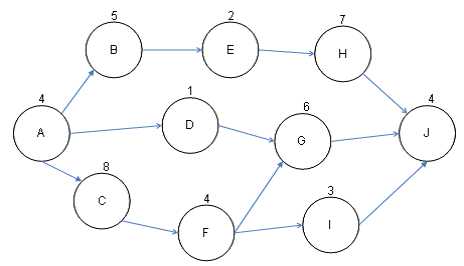
Mary, a project team member, reports that an identified risk is likely to happen in the project that
will affect the completion date of Activity D . She reports that the risk event will likely cause the
duration of the activity to increase by six days. If this happens what is the earliest the project can
complete?
- A. 32 days
- B. 29 days
- C. 27 days
- D. 26 days
Answer:
D
Explanation:
If Activity D increases by six days, the duration of the project will not change. There is 11 days of
float available for Activity D so it may delay by six days without affecting the project end date. What
is float? Float or total float (TF) is the total amount of time that a schedule activity may be delayed
from its early start date without delaying the project finish date, or violating a schedule constraint. It
is calculated by using the critical path method technique and determining the difference between
the early finish dates and late finish dates. Answer options A, B, and C are incorrect. These are not
valid answers for the question.