Nutanix ncp-mca practice test
Multicloud Automation
Question 1
In order to give Consumers the ability to modify attributes, what should the Blueprint creator
implement in the design?
- A. Custom actions
- B. eScript task with custom macros
- C. Runtime variables
- D. HTTP task with built-in macros
Answer:
C
Explanation:
Runtime variables are variables that can be modified by the Consumer during the deployment of a
Blueprint or after the deployment is complete. They allow the Consumer to customize the attributes
of the infrastructure and applications according to their needs. Runtime variables can be defined in
the Blueprint settings or in the Blueprint YAML file. They can also be used in the Blueprint tasks to
pass dynamic values to the scripts or commands. Runtime variables can be of different types, such as
text, number, boolean, list, or password. They can also have default values, constraints, and
descriptions to guide the Consumer.
Reference:
Nutanix Certified Professional - Multicloud Automation (NCP-MCA) Exam Blueprint Guide
, Section 2,
Objective 2.1
Nutanix Multicloud Automation Administration (NMCAA) Course
, Module 4, Lesson 4.3
Nutanix Calm User Guide, Chapter 4, Section 4.2
Reference: https://portal.nutanix.com/page/documents/details?targetId=Nutanix-Calm-Admin-Operations-Guide-v3_2_7:nuc-nucalm-blueprint-management-c.html
Question 2
Refer to the exhibit.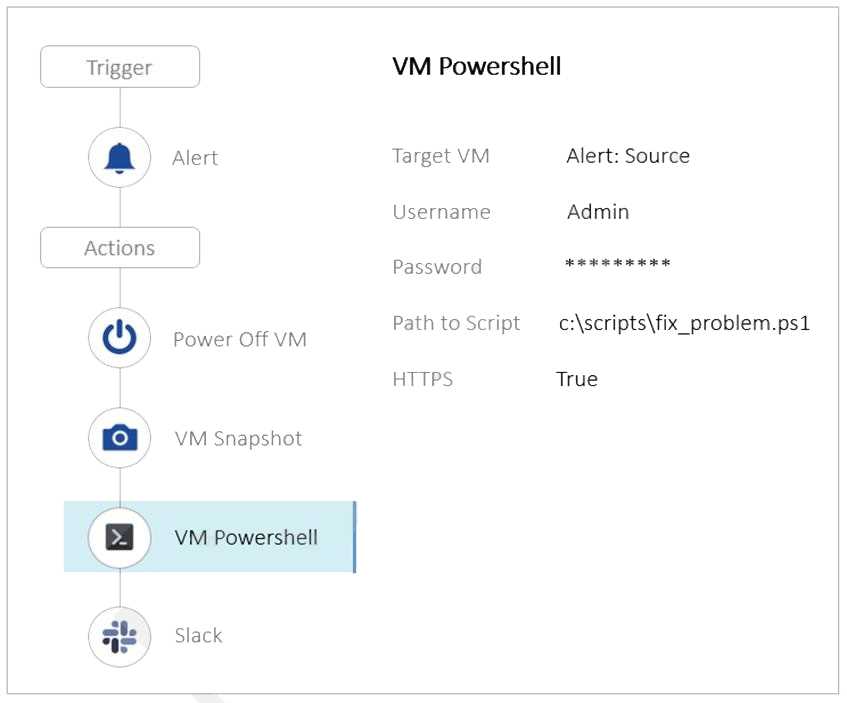
The Playbook is designed to execute a script, in order to fix a known problem in the application.
However, it keeps failing.
Why is this Playbook continuing to fail?
- A. Slack configuration should be reviewed.
- B. The script is incorrect.
- C. The Playbook actions are in the wrong order.
- D. Not enough storage space in order to take a snapshot.
Answer:
C
Explanation:
In the context of Nutanix Multicloud Automation (NCP-MCA), the order of actions in a playbook is
crucial for its successful execution. In this case, the playbook is designed to execute a script to fix a
known problem in an application but keeps failing because it attempts to power off the VM and take
a snapshot before executing the script. The correct order should be to execute the script first, then
power off the VM if necessary, and finally take a snapshot.
Nutanix Certified Professional - Multicloud Automation (NCP-MCA) 6.5 Exam
: This is the official exam
blueprint guide that covers the objectives, topics, and skills required for the certification. It also
provides some sample questions and answers.
Nutanix Certified Professional - Multicloud Automation (NCP-MCA) Exam Blueprint Guide
: This is
another version of the exam blueprint guide that has similar content as the previous one.
Free Questions for NCP-MCA by certscare - p2pexams.com
: This is a PDF document that contains 11
questions and answers for the NCP-MCA exam. The question you asked is one of them, and the
answer is the same as mine.
Question 3
Which action should an administrator use to request a static IP address from an IPAM solution?
- A. Profile
- B. Pre-create
- C. Guest Customization
- D. Create
Answer:
B
Explanation:
When integrating with an IP Address Management (IPAM) solution within Nutanix Calm, an
administrator would use a 'Pre-create' task to request a static IP address. This task is performed
before the actual creation of the VM, ensuring that the IP address is allocated and can be assigned
during the VM's creation process. Profiles (A) are used to define deployment environments, Guest
Customization (C) is used for configuring the OS settings, and Create (D) is typically the task for
provisioning the actual VM, not for requesting an IP.
Question 4
Refer to the exhibit.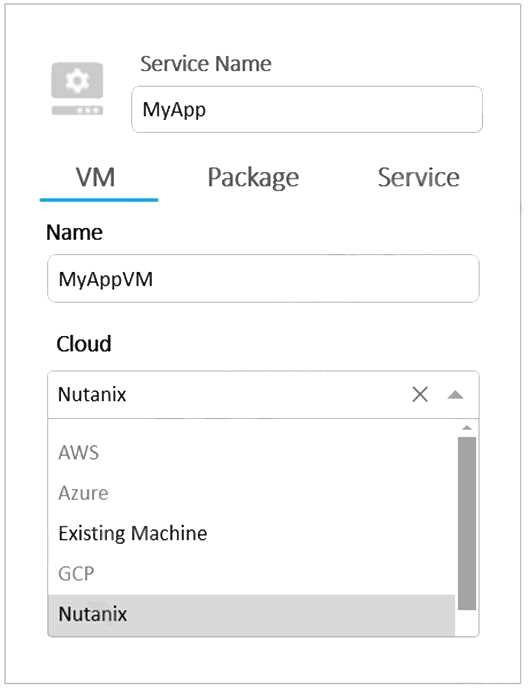
What needs to be done in order to enable the developer to complete this requested task? (Choose
two.)
- A. Create AWS and Azure Providers
- B. Add the Providers to the Project
- C. Enable Environment for AWS and Azure
- D. Upgrade Calm to version 3.2.x
Answer:
AB
Explanation:
In order to enable the developer to complete the requested task, AWS and Azure Providers need to
be created (Option A). This is because, in the context of Nutanix Calm, providers are integrations with
public and private cloud infrastructures. The developer is trying to deploy an application on AWS and
Azure clouds but currently only has Nutanix as a configured provider. After creating the providers,
they need to be added to the project (Option B) so that applications can be deployed on them.
Option C is incorrect because environments are not required for multicloud deployments. Option D is
also incorrect because Calm version 3.2.x is not relevant to the question.
Reference: The information can be verified from Nutanix official training and certification documents
available at
Nutanix Training & Certification
. You can also check out the
Nutanix Certified Professional
- Multicloud Automation (NCP-MCA) 6.5 Exam
guide for more details on the exam objectives and
format. Additionally, you can watch the Nutanix Calm - Multicloud Automation playlist on YouTube
for some video tutorials on Nutanix Calm features and functionalities.
Reference: https://portal.nutanix.com/page/documents/details?targetId=Nutanix-Calm-Admin-
Operations-Guide-v3_3_0:Projects%20and%20Environments
Question 5
A company is new to automation and has infrastructure they would like to automate with Calm to
provide standardized automation. The company also wants to create a Hybrid Cloud environment
with their existing infrastructure which includes AHV, Azure, AWS, and a small legacy vSphere
environment.
In which two locations can Calm be deployed? (Choose two.)
- A. vSphere Essential Edition
- B. VMware ESXi
- C. Nutanix AHV
- D. Any Public Cloud
Answer:
C D
Explanation:
Nutanix Calm is a cloud-agnostic automation and orchestration solution that can be deployed on
Nutanix AHV or any public cloud platform, such as AWS, Azure, or GCP. Calm can also manage
applications across multiple cloud environments, including hybrid clouds. Calm cannot be deployed
on vSphere Essential Edition or VMware ESXi, as these are not supported hypervisors for Calm.
However, Calm can manage existing VMs on vSphere or ESXi clusters through the VMware
provider. Reference:
Nutanix Calm Configuration and Training1
Nutanix Calm Admin and Operations Guide2
Reference: https://portal.nutanix.com/page/documents/solutions/details?targetId=RA-2093-Nutanix-Calm:top-nutanix-calm-overview.html
Question 6
An administrator wants to be alerted when production VMs become idle. The VMs will be
determined to be idle when CPU usage is lower than 5% for more than 5 minutes. All affected VMs
are categorized as Environment:Production, since they have Flow microsegmentation rules.
What should the administrator do to satisfy this requirement?
- A. Create an alert for all VMs, create a Playbook with this alert as the trigger and send an email as the action.
- B. Create an alert for VMs in the correct category, create a Playbook with this alert as the trigger > take a snapshot > send an email as the action.
- C. Create an alert for all VMs, create a Playbook with this alert as the trigger > reduce 1 CPU > send an email as the action.
- D. Create an alert for VMs in the correct category, create a Playbook with this alert as the trigger and send an email as the action.
Answer:
D
Explanation:
To create an alert for idle VMs, the administrator needs to specify the following parameters:
Scope: Select the category value Environment:Production to filter the VMs that are affected by the
alert.
Metric: Select CPU Usage (%) as the metric to monitor the VMs’ CPU utilization.
Condition: Select Less Than as the operator and enter 5 as the threshold value to define the idle
state.
Duration: Enter 5 as the duration value and select Minutes as the unit to set the time period for the
idle state.
To create a Playbook with the alert as the trigger, the administrator needs to do the following steps:
Name: Enter a descriptive name for the Playbook, such as Idle VM Alert.
Trigger: Select Alert as the trigger type and choose the alert that was created for idle VMs.
Action: Select Email as the action type and enter the recipient email address, subject, and message
for the notification.
The Playbook will run whenever the alert is triggered and send an email to the administrator
informing them about the idle VMs.
Reference:
Nutanix Certified Professional Multicloud Automation (NCP-MCA) 6 Exam
, page 9
Nutanix University - NCP-MCA 6 Exam Prep - Alerts and Playbooks
Question 7
A developer has a Development Blueprint that performs the following high level items:
Creates a Windows and Ubuntu Server.
Installs IIS on Windows
Installs MySQL on Ubuntu
As part of Development, there is a need for an Operator to restart IIS Services for troubleshooting
purposes.
How should the developer add this functionality to the Blueprint?
- A. Add an Execute Task in the Restart Action of the Application Profile.
- B. Add an Execute Task in the Restart Action of the Windows/IIS Service.
- C. Add a Delay Task in the Restart Action of the Windows/IIS Service.
- D. Create an Endpoint for the IIS server and a Runbook that restarts the service.
Answer:
B
Explanation:
The Restart Action of a Service allows the developer to define custom tasks that will be executed
when the service is restarted. An Execute Task can run any script or command on the target VM, such
as restarting the IIS service. This way, the Operator can use the Self-Service Portal to restart the
service without logging into the VM or using another tool.
Reference:
Nutanix Certified Professional - Multicloud Automation (NCP-MCA) v6.5
, Section 2, Objective 2.1:
Given a scenario, create a blueprint to deploy infrastructure and applications using Self-Service.
Nutanix Certified Professional Multicloud Automation (NCP-MCA) 6 Exam
, Page 11, Section 2,
Objective 2.1: Given a scenario, create a blueprint to deploy infrastructure and applications using
Self-Service.
Question 8
An administrator receives the following error while running a script through Calm on VM:
Which two conditions could cause this issue? (Choose two.)
- A. The VM port is not allowed by the firewall.
- B. The credentials have insufficient permissions.
- C. The VM is still in the boot process.
- D. There is an error in the script.
Answer:
A, B
Explanation:
The error “Connection refused” can occur due to several reasons but in the context of running a
script through Calm on VM, it is most likely caused by firewall restrictions or insufficient permissions.
Option A suggests that the VM port is not allowed by the firewall, meaning that the firewall settings
are preventing the connection. This could be because specific ports needed for the script to run are
being blocked. Option B indicates that the credentials have insufficient permissions, meaning that
the user or system trying to execute the script does not have the necessary permissions to establish a
connection. Option C is unlikely because the VM should be ready before the script is executed.
Option D is possible but not specific enough to explain the connection issue. Reference: You can find
more information about this topic in the following sources:
Nutanix Certified Professional - Multicloud Automation (NCP-MCA) Exam Blueprint Guide
, Section 3 -
Validate Blueprints, Runbooks, Playbooks, and Automation Settings, page 9
Nutanix Multicloud Automation Administration (NMCAA)
, Module 5 - Troubleshooting, Lesson 1 -
Troubleshooting Calm, page 5-4
Question 9
When creating a blueprint, which Pre-create and Post-delete tasks are valid?
- A. Create, Start, Stop, Delete
- B. Execute, Set variable, HTTP, Delay
- C. Create, Start, Stop, Soft Delete
- D. Execute, Set variable, API, Delay
Answer:
B
Explanation:
Pre-create and Post-delete tasks are actions that can be performed before creating or after deleting a
blueprint deployment. They can be used to integrate with external systems, set variables, or add
delays. The valid tasks are Execute, Set variable, HTTP, and Delay. Create, Start, Stop, and Delete are
not valid tasks, as they are part of the deployment lifecycle, not the pre-create or post-delete
actions. Reference:
Nutanix Certified Professional - Multicloud Automation (NCP-MCA) Exam
Blueprint Guide
, page 10;
Nutanix Multicloud Automation Administration (NMCAA) Course
, Module
5: Blueprints.
Reference: https://portal.nutanix.com/page/documents/details?targetId=Nutanix-Calm-Admin-Operations-Guide-v3_2_7:nuc-pre-create-task-overview-c.html
Question 10
Which two groups of operations can a Prism Admin or Super Admin role perform? (Choose two.)
- A. Create, read, automate, or delete an action template in the action gallery
- B. Create, read, update, or delete an action template in the action gallery
- C. Create, read, automate, delete, enable, and run playbooks
- D. Create, read, update, delete, enable, and run playbooks
Answer:
B, D
Explanation:
A Prism Admin or Super Admin role can perform the following operations related to X-Play and
Nutanix Calm12
:
Create, read, update, or delete an action template in the action gallery
Create, read, update, delete, enable, and run playbooks
Create, read, update, delete, enable, and run blueprints and runbooks
Manage applications and projects
Configure endpoints and plug-ins
Access the library and categories Option A is incorrect because the action gallery does not support
automation of action templates.
Option C is incorrect because only a Prism Admin or Super Admin
role can enable and run playbooks, not a Prism User role3
. Reference:
Nutanix Certified Professional - Multicloud Automation (NCP-MCA) v6.5
Nutanix Multicloud Automation Administration (NMCAA)
Prism user permissions – what are the options?
Reference: https://portal.nutanix.com/page/documents/details?targetId=Nutanix-Security-Guide-v5_16:wc-user-management-using-pe-topichead.html
Question 11
A blueprint was developed for deploying a standard 3-tier hosting environment for a company's
applications. The blueprint includes a load balancer, multiple web servers, a database server, and a
small test application.
During testing of the blueprint, the application fails to connect to the database. The cause is found to
be the database software is still installing when the application starts.
Which method most efficiently prevents the application from starting before the database?
- A. Use a local install instead of downloading
- B. Create a loop to retry connection
- C. Create a service dependency
- D. Use a sleep statement in a start script
Answer:
C
Explanation:
A service dependency is a feature of Nutanix Calm that allows you to define the order of execution
and the conditions for starting and stopping services in a blueprint. By creating a service dependency
between the application and the database, you can ensure that the application will not start until the
database is fully installed and ready. This avoids the need for manual intervention or inefficient
workarounds like loops or sleep statements. Reference:
Nutanix Multicloud Automation
Administration (NMCAA)
, page 41;
Nutanix Certified Professional - Multicloud Automation (NCP-
MCA)
, section 2.
Reference: https://portal.nutanix.com/page/documents/details?targetId=Nutanix-Calm-Admin-
Operations-Guide-v3_2_7:Nutanix-Calm-Admin-Operations-Guide-v3_2_7
Question 12
Which Prism Central setting must first be configured in order to add users to a Project?
- A. HTTP Proxy
- B. Authentication Directory
- C. Pulse
- D. Local User Role Mapping
Answer:
B
Explanation:
In order to add users to a Project, the Prism Central administrator must first configure an
Authentication Directory. This is a service that provides user authentication and authorization for
Prism Central, such as Active Directory or OpenLDAP. By configuring an Authentication Directory, the
administrator can enable users to log in to Prism Central using their existing credentials and assign
them roles and permissions based on their group membership. The administrator can also create
local user accounts for users who do not belong to any Authentication Directory.
Reference:
Nutanix Certified Professional - Multicloud Automation (NCP-MCA) Exam Blueprint Guide
, Section 2,
Objective 2.5
Nutanix Multicloud Automation Administration (NMCAA) Course
, Module 2, Lesson 2.2
Configuring Authentication | Nutanix Community
Reference: https://download.nutanix.com/documentation/v60/Prism-Central-Guide-Prism-v6_0.pdf
Question 13
A customer is trying to deploy an application with Calm and receives this error for a Linux VM:
What is the cause of this error within the blueprint?
- A. Connection section has a network adapter selected for the Address box in Connection section.
- B. Connection section has no network adapters selected for the Address box in Connection section.
- C. Connection Type has a protocol selected.
- D. Connection Type has no protocol selected.
Answer:
B
Explanation:
In the context of deploying an application with Calm, if a customer receives an error for a Linux VM,
it could be due to the absence of network adapters selected for the Address box in the Connection
section within the blueprint. This means that there is no specified network connection for the VM,
leading to a failure in script execution.
Nutanix Certified Professional - Multicloud Automation (NCP-MCA) Exam Blueprint Guide
: This is the
official exam blueprint guide that covers the objectives, topics, and skills required for the
certification. It also provides some sample questions and answers. The question you asked is similar
to the one in section 3.1.1.
Nutanix Multicloud Automation Administration (NMCAA)
: This is a training course that teaches you
the skills needed to install, configure, operate, and manage Nutanix X-Play and Nutanix Calm. It
includes topics such as blueprint creation, connection configuration, and script execution.
Nutanix Calm User Guide
: This is a user guide that explains how to use Nutanix Calm to automate the
deployment and management of applications across different environments. It includes topics such
as connection settings, blueprint validation, and error handling.
Question 14
Which method will result in unique names per VM when scaling out a Service in a Calm Blueprint?
- A. Guest OS customization using sysprep contains <ComputerName>@@{name}@@</ComputerName>.
- B. Service VM Name field contains the macro variable @@{calm_array_index}@@.
- C. Call an external Python eScript that uses an IPAM API to register the VM name in DNS.
- D. Set the VM Name field to allow user edits at launch so the user can enter a custom value at launch.
Answer:
B
Explanation:
The correct method to result in unique names per VM when scaling out a Service in a Calm Blueprint
is to use the macro variable @@{calm_array_index}@@ in the Service VM Name field (Option B).
This variable will append a unique index number to each VM name based on the scale-out count. For
example, if the Service VM Name is MyAppVM-@@{calm_array_index}@@ and the scale-out count
is 3, the resulting VM names will be MyAppVM-0, MyAppVM-1, and MyAppVM-2. Option A is
incorrect because the <ComputerName> tag in the sysprep file will only affect the hostname of the
guest OS, not the VM name in the cloud provider. Option C is incorrect because calling an external
Python eScript to register the VM name in DNS will not change the VM name in the cloud provider
either. Option D is incorrect because setting the VM Name field to allow user edits at launch will
require manual input from the user for each VM, which is not scalable or automated.
Reference: The information can be verified from Nutanix official training and certification documents
available at
Nutanix Training & Certification
. You can also check out the
Nutanix Certified Professional
- Multicloud Automation (NCP-MCA) 6.5 Exam
guide for more details on the exam objectives and
format. Additionally, you can watch the
Nutanix Calm - Multicloud Automation
playlist on YouTube
for some video tutorials on Nutanix Calm features and functionalities.
Reference: https://portal.nutanix.com/page/documents/details?targetId=Nutanix-Calm-Admin-Operations-Guide-v3_2_7:nuc-multi-vm-blueprints.html
Question 15
Which two providers are supported in Calm? (Choose two.)
- A. Oracle Cloud
- B. Kubernetes
- C. GCP
- D. IBM Cloud
Answer:
B, C
Explanation:
Nutanix Calm supports various providers to manage and orchestrate applications across different
cloud environments. Providers are the cloud platforms or services that host the VMs or containers
that run the application components.
Calm supports the following providers12
:
Nutanix AHV
VMware vSphere
AWS
Azure
GCP
Kubernetes
Bare Metal
OpenStack
Cloud-Init
Terraform
Among the options given, only Kubernetes and GCP are supported providers in Calm. Oracle Cloud
and IBM Cloud are not supported providers in Calm. Reference:
1: Nutanix Calm Admin and Operations Guide3
2: Nutanix Calm Configuration and Training4
Reference: https://portal.nutanix.com/page/documents/details?targetId=Nutanix-Calm-Admin-Operations-Guide-v3_2_7:nuc-nucalm-major-components-c.html