comptia pk0-005 practice test
CompTIA Project+
Question 1
SIMULATION
During a gate review meeting, the deliverable was rejected by the customer.
INSTRUCTIONS
Review the dashboard.
• Part 1: Drag and drop each task, placing them in the correct order based on the project change
control process.
• Part 2: Select the proper document(s) to be updated.
If at any time you would like to bring back the initial state of the simulation, please click the Reset All
button.
Part 1:
Part 2: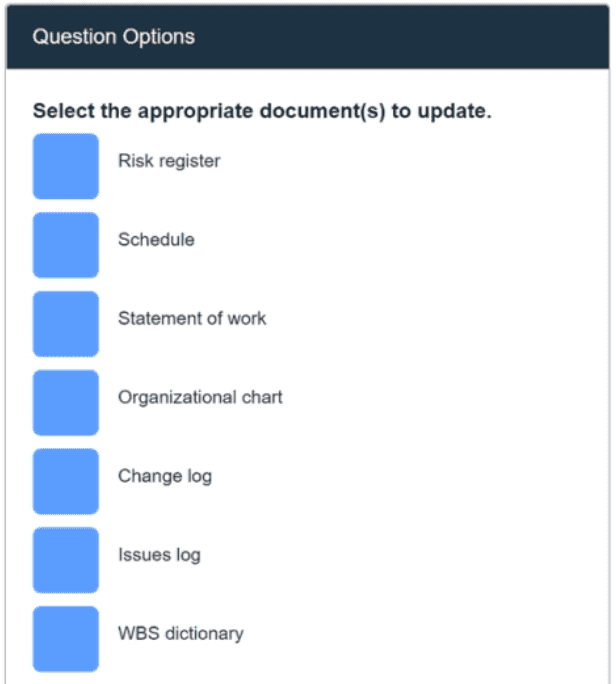
Answer:
See the
Explanation for the
solution.
Explanation:
Part 1:
Change Control Process:
Consult the RACI matrix.
Define new requirements and record changes.
Assess the schedule, risk, and cost.
Perform a demonstration.
Obtain a sign off.
Update and test the deliverable.
Make an announcement on the company portal.
The change control process is a sequence of steps that helps to manage and document any changes
or modifications to a project scope, schedule, cost, quality, or resources. The change control process
typically involves the following steps:
Consult the RACI matrix. A RACI matrix is a tool that defines and clarifies the roles and
responsibilities of each team member for each task or activity in a project. RACI stands for
responsible, accountable, consulted, and informed. Consulting the RACI matrix can help to identify
who needs to be involved or informed about the change request and how to communicate with
them.
Define new requirements and record changes. The new requirements and changes are the details of
what needs to be modified or added to the project deliverables or objectives based on the customer
feedback or request. Defining and recording the new requirements and changes can help to
communicate and justify the need and rationale for the change and its implications on the project
scope and quality.
Assess the schedule, risk, and cost. The schedule, risk, and cost are the aspects of the project that
may be affected by the change request. Assessing the schedule, risk, and cost can help to determine
the impact and feasibility of the change and identify any possible alternatives or corrective actions to
minimize or avoid its negative effects.
Perform a demonstration. A demonstration is a presentation or show of how the modified or
updated deliverable works or meets the customer expectations or requirements. Performing a
demonstration can help to validate and verify that the change request has been implemented
correctly and effectively and to obtain feedback or approval from the customer or stakeholders.
Obtain a sign off. A sign off is a formal acceptance and approval of the change request and its
deliverables from the customer or stakeholders. Obtaining a sign off can help to confirm that the
change request has been completed successfully and satisfactorily and to close the change control
process.
Update and test the deliverable. The deliverable is the product or service that is produced or
provided by the project. Updating and testing the deliverable can help to ensure that it meets the
quality standards and criteria and that it works as expected after implementing the change request.
Make an announcement on the company portal. The company portal is a platform or channel that
allows internal communication and collaboration among employees within an organization. Making
an announcement on the company portal can help to inform and update other team members or
departments about the change request and its outcomes and to share any lessons learned or best
practices from the change control process.
Part2:
Risk register: A risk register is a document that identifies, analyzes, and records the potential risks or
uncertainties that may affect a project. Updating the risk register can help to capture any new or
modified risks that may arise from the change request and to plan and implement appropriate risk
responses.
Schedule: A schedule is a document that shows the planned start and end dates, durations,
dependencies, and progress of each task or activity in a project. Updating the schedule can help to
reflect any changes or adjustments to the project timeline or milestones that may result from the
change request and to monitor and control the project performance and delivery.
Statement of work: A statement of work (SOW) is a document that defines the scope, deliverables,
schedule, and terms and conditions of a project or contract. Updating the SOW can help to document
any changes or additions to the project scope or deliverables that may be requested or agreed upon
by the customer or stakeholders and to ensure alignment and agreement on what needs to be done
and how it will be done.
Change log: A change log is a document that tracks and records any changes or modifications that are
made to the project scope, schedule, cost, quality, or resources during a project. Updating the
change log can help to document the change request, approval, implementation, and impact of each
change and ensure traceability and transparency.
Question 2
A PM is responsible for implementing a new customer relationship management system and has
learned that the sales organization is reluctant to utilize the new system. The organization's
reluctance could jeopardize the success of the project. Which of the following steps should be taken
to understand the adoption issues and gain organizational acceptance of the initiative? (Select TWO).
- A. Train users on the proper use of the system.
- B. Escalate the issue to the CCB
- C. Hold sessions to understand user challenges.
- D. Track system usage and report user activity.
- E. Log the issue in the project risk register.
- F. Create a memorandum of acceptable use.
Answer:
C,D
Explanation:
The project manager should hold sessions to understand user challenges and track system usage and
report user activity. These steps will help the project manager to identify the root causes of the
adoption issues and monitor the progress of the system utilization. They will also help to
communicate with the sales organization and provide feedback and support12
Question 3
Following a successful release, a project manager sent a survey to all stakeholders to gain an
understanding of opportunity areas for the team. Which of the following can use the survey results
as an input?
- A. Daily stand-up
- B. Project momentum
- C. Performance feedback
- D. Meeting minutes
Answer:
C
Explanation:
The project manager can use the survey results as an input for performance feedback for the project
team members. Performance feedback is a process of providing constructive and timely information
on the performance of individuals or teams in relation to project goals and
expectations. Performance feedback can help to motivate, improve, and recognize project team
members345
The survey results can be used as an input for performance feedback. Performance feedback involves
analyzing and evaluating the performance of the project team and project management against the
project plan, including identifying areas for improvement. The survey results can help identify these
areas for improvement and provide feedback to the project team on their performance. Reference:
CompTIA Project+ Study Guide Section 4.1.1
Question 4
Which of the following is an activity that should be used in the closing phase of a project to support
the project triple constraint?
- A. Evaluating the project
- B. Releasing the resources
- C. Closing the contracts
- D. Reconciling the budget
Answer:
A
Explanation:
Evaluating the project is an activity that should be used in the closing phase of a project to support
the project triple constraint. This involves reviewing the project plan, deliverables, and outcomes to
ensure they meet the project objectives and requirements. Reference: CompTIA Project+ Study
Guide Section 4.4.4
Question 5
During a quality analysis review, the causes of several issues have been highlighted. Which of the
following should the project manager use to identify the MOST important causes?
- A. Ishikawa diagram
- B. Scatter diagram
- C. Pareto chart
- D. Decision tree
Answer:
C
Explanation:
The Pareto chart should be used to identify the most important causes of issues during a quality
analysis review. The Pareto chart is a graphical representation of the frequency and impact of
different causes, helping to identify the most common and impactful causes. Reference: CompTIA
Project+ Study Guide Section 3.3.3
Question 6
Which of the following BEST describes how an organization should coordinate management of
multiple related projects?
- A. Apply the SDLC process.
- B. Establish a program.
- C. Consult the CCB.
- D. Use different frameworks
Answer:
B
Explanation:
The BEST way to coordinate management of multiple related projects is to establish a program. A
program is a group of related projects that are managed together to achieve specific strategic
business objectives. Reference: CompTIA Project+ Study Guide Section 2.2.1
The organization should establish a program to coordinate management of multiple related projects.
A program is a group of related projects, subprograms, and program activities that are managed in a
coordinated way to obtain benefits and control not available from managing them individually. A
program can help to align multiple projects with strategic goals, optimize resources and risks, and
deliver value to stakeholders.
Question 7
A project team gathers weekly to review its progress. Which of the following is the project manager
MOST likely to have prepared to ensure team members who are absent remain informed about
assignments?
- A. Status report
- B. Project plan
- C. Change log
- D. Meeting minutes
Answer:
D
Explanation:
Meeting minutes should be prepared to ensure team members who are absent remain informed
about assignments. Meeting minutes document what was discussed, decisions made, and
assignments given during a meeting, providing a record of the team's progress and ensuring absent
members are up-to-date. Reference: CompTIA Project+ Study Guide Section 4.2.2
The project manager should prepare meeting minutes to ensure team members who are absent
remain informed about assignments. Meeting minutes are a written record of what was discussed
and decided in a meeting. They usually include information such as attendees, agenda items, action
items, decisions made, issues raised, and deadlines assigned. Meeting minutes can help to
communicate important information to team members who could not attend the meeting and
provide a reference for future follow-up.
Question 8
A project manager prefers to have immediate contact with team members because it allows for
faster response times and more interactive discussions. Which of the following communication
methods should the project manager use?
- A. Synchronous
- B. Informal
- C. Asynchronous
- D. Formal
Answer:
A
Explanation:
The project manager should use synchronous communication methods if they prefer to have
immediate contact with team members. Synchronous communication is a type of communication
that occurs in real time and allows for faster response times and more interactive discussions.
Examples of synchronous communication methods include phone calls, video conferences, instant
messaging, and face-to-face meetings. Synchronous communication can help to build rapport, clarify
doubts, and resolve issues quickly among team members.
Synchronous communication should be used when the project manager prefers to have immediate
contact with team members. Synchronous communication allows for real-time interaction and
feedback, enabling faster response times and more interactive discussions. Reference: CompTIA
Project+ Study Guide Section 3.1.3
Question 9
As part of the planning phase, a PM has defined tasks, durations, resources, and costs. Which of the
following is the NEXT step in the process?
- A. Update the work breakdown structure.
- B. Review the backlog.
- C. Seek baseline approval.
- D. Establish the resource pool.
Answer:
C
Explanation:
The next step in the process after defining tasks, durations, resources, and costs is to seek baseline
approval. A baseline is an approved version of a project plan that serves as a reference point for
measuring progress and performance throughout the project lifecycle. A baseline typically includes
scope, schedule, cost, quality, and risk parameters. Seeking baseline approval involves presenting the
project plan to key stakeholders and obtaining their formal agreement on the project objectives and
deliverables. Baseline approval can help to establish clear expectations, avoid scope creep, and
facilitate change control during project execution.
The NEXT step after defining tasks, durations, resources, and costs during the planning phase is to
seek baseline approval. Baseline approval involves finalizing the project plan and gaining approval
from stakeholders, establishing the plan as the baseline for the project's performance. Reference:
CompTIA Project+ Study Guide Section 3.4.1
Question 10
A project manager realizes that a project will not be completed on time due to resource constraints.
Which of the following actions should the project manager take NEXT?
- A. Trigger the contingency plan and communicate with the stakeholders.
- B. Work with the functional managers to create a work-around.
- C. Submit a change request to the change control board.
- D. Transfer the risk by hiring a new vendor who was successful on a previous project.
- E. Set up an escalation meeting with the sponsor.
Answer:
C
Explanation:
Submit a change request to the change control board. The project manager should submit a change
request to the change control board (CCB) if they realize that the project will not be completed on
time due to resource constraints. A change request is a formal proposal to modify any aspect of the
project, such as scope, schedule, cost, quality, or resources. A change request must be submitted to
the CCB, which is a group of stakeholders who are authorized to review and approve
changes. Submitting a change request can help to document the impact of the resource constraints
on the project and seek approval for any corrective actions or preventive actions12
Question 11
By developing a project schedule, a PM has already validated the constraints, outlined the duration
of the tasks and the phases, and confirmed the proper sequence and flow of the project. Which of
the following activities still needs to be performed to complete the schedule?
- A. Allocate resources.
- B. Determine the project budget
- C. Develop a communication plan.
- D. Establish baselines.
Answer:
D
Explanation:
The next step after defining tasks, durations, resources, and costs is to establish baselines. A baseline
is an approved version of a project plan that serves as a reference point for measuring progress and
performance throughout the project lifecycle. A baseline typically includes scope, schedule, cost,
quality, and risk parameters. Establishing baselines involves presenting the project plan to key
stakeholders and obtaining their formal agreement on the project objectives and
deliverables. Baseline approval can help to establish clear expectations, avoid scope creep, and
facilitate change control during project execution34
Question 12
A PM has identified all the resources involved in a project. The next step is to identify which
resources are responsible for which tasks. Which of the following should be used to document this
information?
- A. RFI
- B. RACI
- C. WBS
- D. SOW
Answer:
B
Explanation:
The RACI (Responsible, Accountable, Consulted, Informed) matrix is used to document which
resources are responsible for which tasks. The RACI matrix is a tool that helps to clarify roles and
responsibilities on a project. It assigns a level of responsibility to each resource involved in the
project. Reference: CompTIA Project+ Study Guide Section 3.4.
The project manager should use a RACI matrix to document which resources are responsible for
which tasks. A RACI matrix is a type of responsibility assignment matrix (RAM) that plots the roles
and responsibilities of resources on a project team. RACI stands for Responsible, Accountable,
Consulted, and Informed. A RACI matrix can help to clarify who does what on a project, avoid
confusion and duplication of work, and improve communication and collaboration among team
members.
Question 13
During a staff meeting, a project manager voices a concern about the client billing rate for a
particular engineer. Which of the following documents would the project manager need in order to
find this information?
- A. SLA
- B. TOR
- C. SOW
- D. NDA
Answer:
C
Explanation:
In order to find the client billing rate for a particular engineer, the project manager would need to
refer to the SOW (Statement of Work). The SOW is a document that outlines the work to be
performed, the timeframe for completion, and the cost of the project. It also includes information
about the resources involved in the project and their billing rates. Reference: CompTIA Project+
Study Guide Section 2.2.
The project manager would need a statement of work (SOW) to find information about the client
billing rate for a particular engineer. A SOW is a document that defines the scope of work for a
project or contract. It usually includes information such as deliverables, milestones, timeline, costs,
payment terms, quality standards, and acceptance criteria. A SOW can help to specify what services
or products will be provided by whom, when, where, how, and for how much.
Question 14
Which of the following should occur when implementing an IT infrastructure change that takes risks
into consideration?
- A. Approving the change request
- B. Developing a rollback plan
- C. Gathering necessary resources
- D. Defining requirements
Answer:
B
Explanation:
When implementing an IT infrastructure change that takes risks into consideration, the project
manager should develop a rollback plan. A rollback plan is a contingency plan that outlines the steps
that need to be taken in case the change does not work as expected. It includes a plan to roll back
the changes and restore the system to its previous state. Reference: CompTIA Project+ Study Guide
Section 3.3.
The project manager should develop a rollback plan when implementing an IT infrastructure change
that takes risks into consideration. A rollback plan is a contingency plan that describes how to revert
back to the previous state of the system in case of a failure or disruption during the change
implementation. A rollback plan can help to minimize the impact of the change on the system
performance and availability and ensure business continuity and data integrity.
Question 15
During the stabilization phase for recently deployed software, an end user reports a bug that is
compromising data integrity. Which of the following tools will the project manager MOST likely use?
- A. Issue log
- B. Defect log
- C. Change log
- D. Task board
Answer:
B
Explanation:
During the stabilization phase of recently deployed software, the project manager will most likely use
a defect log to track and manage reported bugs. A defect log is a document that contains information
about the defects or issues identified during testing or after the deployment of software. It includes
the severity of the defect, the steps to reproduce the problem, and the actions taken to resolve the
defect. Reference: CompTIA Project+ Study Guide Section 4.1.
The project manager will most likely use a defect log during the stabilization phase for recently
deployed software to record a bug that is compromising data integrity. A defect log is a tool that
tracks and documents any errors or flaws found in a software product or system during testing or
operation. It usually includes information such as defect ID, description, severity, priority, status,
resolution, and responsible person. A defect log can help to monitor and manage the quality of the
software product or system and ensure that all defects are identified and resolved before delivery or
release.