cisco 350-501 practice test
Implementing and Operating Cisco Service Provider Network Core Technologies (SPCOR)
Question 1
Egress PE NAT is being used via a single centralized router to provide Internet access to L3VPN customers.
Which description of the NAT operation is true?
- A. Users m different VRFs cannot share the same outside global IP address
- B. The NAT table contains a field to identify the inside VRF of a translation
- C. Multiple address pools are needed for the same L3VPN because each site has a separate NAT
- D. The different L3VPNs using the Internet access must not have IP overlaps internally
Answer:
B
Explanation:
Egress PE NAT via a single centralized router allows L3VPN customers to access the internet. The NAT operation maintains a
table that includes a field to identify the inside VRF of a translation. This is crucial for distinguishing between different
customer VPNs that may use overlapping IP address spaces.
By having this field, the NAT process can correctly associate
each internal IP with its respective VRF and outside global IP address1
. Reference:
Centralized egress to internet
,
Egress PE
NAT single centralized router
.
Question 2
http://www.justcerts.com
P-
How much must the MTU be increased when configuring the 802.1q VLAN tag?
- A. 2 bytes
- B. 4 bytes
- C. 8 bytes
- D. 12 bytes
Answer:
B
Explanation:
When configuring the 802.1q VLAN tag, the MTU must be increased by 4 bytes. This is because the 802.1Q tag adds an
additional header to the Ethernet frame, which includes information such as the VLAN ID and priority.
To accommodate this
extra header without fragmenting the packet, the MTU must be increased accordingly2
. Reference:
Configure 802.1Q VLAN
Tagging
,
802.1q and MTU
.
Question 3
Refer to the exhibit: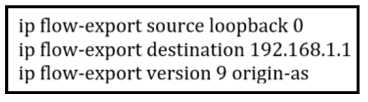
Export statistics received do not include the BGP next hop.
Which statement about the NetFlow export statistics is true?
http://www.justcerts.com
P-
- A. Only the origin AS of the source router will be included in the export statistics.
- B. Loopback 0 must be participating in BGP for it to be included in the export statistics.
- C. The origin AS and the peer-as will be included in the export statistics.
- D. To include the BGP next hop in the export statistics, those keywords must be included with the version 9 entry.
Answer:
D
Explanation:
In NetFlow export statistics, the BGP next hop information is not included by default. To include the BGP next hop in the
export statistics, specific keywords related to BGP next hop must be configured with the version 9 NetFlow entry. This
configuration allows for the measurement of network traffic on a per-BGP next hop basis, which is essential for detailed
traffic analysis and accounting1. Reference: Configuring NetFlow BGP Next Hop Support for Accounting and Analysis - Cisco
Systems1.
Question 4
Refer to the exhibit:
http://www.justcerts.com
P-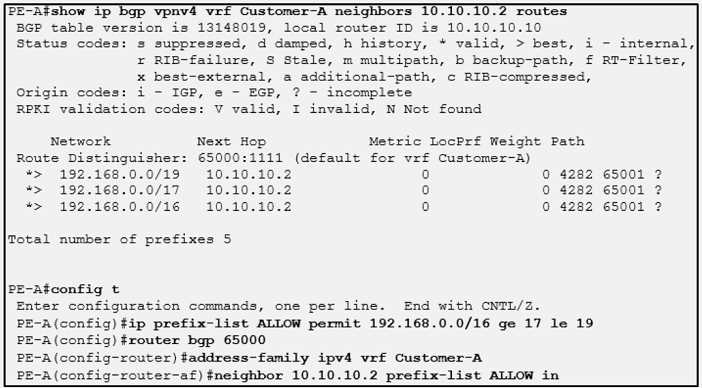
Which three outcomes occur if the prefix list is added to the neighbor? (Choose three)
- A. 192.168 0.0/19 is denied.
- B. 192.168 0.0/17 is denied.
- C. 192.168 0.0/17 is permitted
- D. 192.168.0.0/16 is denied
- E. 192.168 0.0/16 is permitted
- F. 192.168 0.0/19 is permitted
Answer:
A, D, E
Explanation:
When a prefix list is applied to a BGP neighbor, it filters routes based on the specified conditions. In this scenario, the prefix
list is designed to permit prefixes that are equal to or longer than /17 but shorter than or equal to /19. Therefore:
http://www.justcerts.com
P-
A: 192.168.0.0/19 is denied because it falls outside the specified range.
D: 192.168.0.0/16 is denied as it is shorter than the minimum length of /17.
E: 192.168.0.0/16 is permitted because it is the exact prefix specified in the prefix list, and the ge and le modifiers apply to
more specific routes derived from this prefix. Reference: Implementing and Operating Cisco Service Provider Network Core
Technologies (SPCOR) - Cisco official courseware.
Question 5
Which statement about segment routing prefix segments is true?
- A. It is linked to a prefix SID that is globally unique within segment routing domain.
- B. It is the longest path to a node.
- C. It is linked to an adjacency SID that is globally unique within the router.
- D. It requires using EIGRP to operate.
Answer:
A
Explanation:
Segment routing prefix segments are linked to a prefix SID that is globally unique within the segment routing domain.
This
means that each prefix SID identifies a specific prefix in the network and is unique across the entire segment routing-
enabled domain, ensuring that the path to the prefix can be identified and used by any node within the
domain1. Reference: Introduction to Segment Routing - Cisco Learning Network2, ASR9000/XR Introduction to Segment
Routing - Cisco Community3, About Segment Routing - Cisco Content Hub
Question 6
DRAG DROP
Drag and drop the functions from the left onto the correct Path Computation Element Protocol roles on the right
http://www.justcerts.com
P-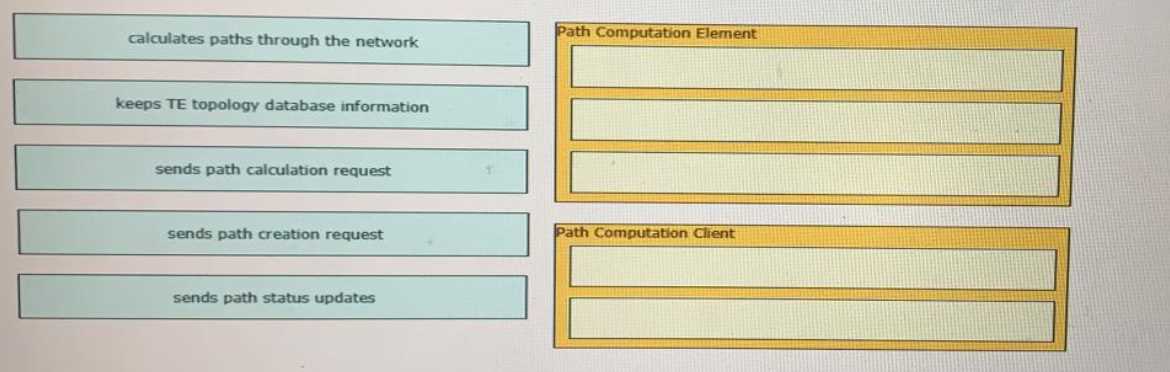
Answer:
Explanation:
Path Computation Element (Calculates paths through the network, keeps TE topology database information, sends path
status updates)
Path computation Client (sends path calculation request, sends path creation request)
Path Computation Element (PCE)
Represents a software module (which can be a component or application) that enables the router to compute paths
applying a set of constraints between any pair of nodes within the router’s TE topology database. PCEs are discovered
through IGP.
Path Computation Client (PCC)
Represents a software module running on a router that is capable of sending and receiving path computation requests and
responses to and from PCEs. The PCC is typically an LSR (Label Switching Router).
https://www.cisco.com/c/en/us/td/docs/routers/crs/software/crs_r5-3/mpls/configuration/guide/b-mpls-cg53x-crs/b-mpls-cg53x-crs_chapter_0110.html#con_1279822
Question 7
You are creating new Cisco MPLS TE tunnels. Which type of RSVP message does the headend router send to reserve
bandwidth on the path to the tunnel’s router?
- A. error
- B. reservation http://www.justcerts.com P-
- C. path
- D. tear
Answer:
C
Explanation:
When creating new Cisco MPLS TE tunnels, the headend router sends a Path message to reserve bandwidth on the path to
the tunnel’s tailend router. The Path message is part of the RSVP (Resource Reservation Protocol) used in signaling and
establishing MPLS TE tunnels.
It carries information about the requested resources and desired parameters for the
tunnel123
. Reference:
Configuring MPLS TE RSVP
,
MPLS TE RSVP-TE
,
MPLS TE Theory
.
Question 8
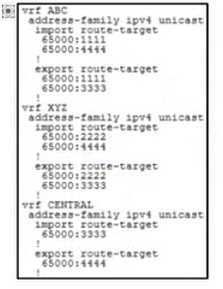
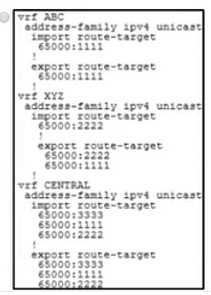
An engineer is setting up overlapping VPNs to allow VRF ABC and XYZ to communicate with VRF CENTRAL but wants to
make sure that VRF ABC and XYZ cannot communicate. Which configuration accomplishes these objectives?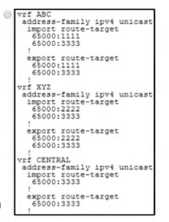
http://www.justcerts.com
P-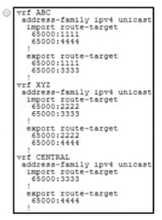
- A. Option A http://www.justcerts.com P-
- B. Option B
- C. Option C
- D. Option D
Answer:
C
Explanation:
the configuration should ensure that VRF ABC and XYZ have route targets that allow them to import routes from VRF
CENTRAL, but not from each other.
This can be achieved by careful manipulation of route targets and import/export policies
within the VRF configurations456
.
Question 9
In an MPLS network, which protocol can be used to distribute a Segment Prefix?
- A. OSPF
- B. LDP
- C. RSVP-TE
- D. EIGRP
Answer:
B
Explanation:
In an MPLS network, the Label Distribution Protocol (LDP) is used to distribute labels which can include segment prefixes.
LDP is a protocol that automatically generates and exchanges labels between routers, allowing for the forwarding of
packets along a predetermined path without the need for complex lookups in a routing table at every hop.
Reference: Segment Routing Overview and Migration Guidelines - Cisco1
.
http://www.justcerts.com
P-
Question 10
DRAG DROP
Drag and drop the NAT64 descriptions from the left onto the correct NAT64 types on the right.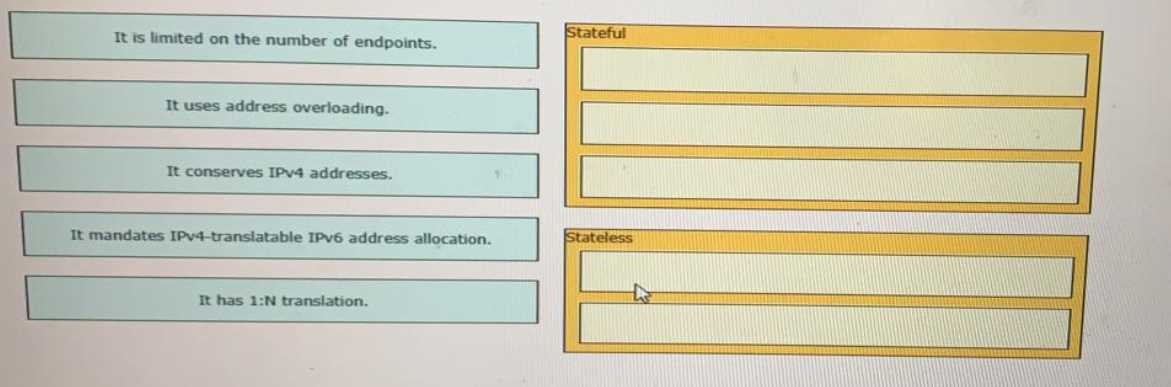
Answer:
Explanation:
Stateful (It has 1: N translation, It uses address overloading, It conservers IPv4 addresses)
Stateless (It is limited on the number of endpoints, It mandates IPv4-translatable IPv6 address allocation)
Question 11
Which statement about Network Services Orchestrator (NSO) is true?
- A. It is used only in service provider environments
- B. It can be used only with XML coding
- C. It uses YANG modeling language to automate devices
- D. It must use SDN as an overlay for addressing
Answer:
C
Explanation:
http://www.justcerts.com
P-
Network Services Orchestrator (NSO) uses the YANG (Yet Another Next Generation) modeling language to provide a
standardized way to automate network devices. YANG provides a powerful schema to model configuration and state data
for network elements, which NSO leverages for service automation and orchestration.
Reference: Cisco Crosswork Network Services Orchestrator (NSO) - Cisco2
.
Question 12
Which task must be performed first to Implement BFD in an IS-IS environment?
- A. Disable Cisco Express Forward.ng on all interfaces running routing protocols other than IS-IS
- B. Configure BFD under the IS-IS process
- C. Configure all ISIS routers as Level 2 devices
- D. Configure BFD in an interface configuration mode
Answer:
D
Explanation:
To implement Bidirectional Forwarding Detection (BFD) in an IS-IS environment, the first task is to configure BFD in an
interface configuration mode. This involves setting up BFD parameters on the interfaces where IS-IS is running to enable
quick failure detection.
Reference: Implementing BFD in an IS-IS Environment - Exam-Answer3
.
Question 13
An engineer working for telecommunication company with an employee id: 3715 15 021 needs to secure the LAN network
using a prefix list Which best practice should the engineer follow when he implements a prefix list?
http://www.justcerts.com
P-
- A. An engineer must use non sequential sequence numbers in the prefix list so that he can insert additional entries later.
- B. The final entry in a prefix list must be /32
- C. An engineer must identity the prefix list with a number only
- D. An engineer must include only the prefixes for which he needs to log activity.
Answer:
A
Explanation:
When implementing a prefix list, it is a best practice to use nonsequential sequence numbers. This allows for the insertion
of additional entries at a later time without the need to renumber the entire list, providing flexibility in managing the prefix
list.
Reference: Best Practices for Implementing a Prefix List - exam-answer.com4
.
Question 14
Refer to the exhibit: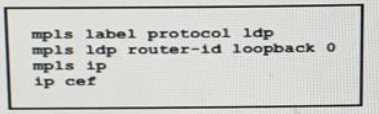
A network operator working for service provider with an employee id 3715 15:021 applied this configuration to a router.
Which additional step should the engineer use to enable LDP?
- A. Disable Cisco Express Forwarding globally
- B. Delete the static router ID
- C. Enable MPLS LDP on the interface
- D. Configure the both keyword to enable LDP globally http://www.justcerts.com P-
Answer:
C
Explanation:
The configuration snippet shows that MPLS and LDP are configured globally but not enabled on an interface. The
commands include “mpls label protocol ldp,” “mpls ldp router-id loopback 0,” and “mpls ip,” which are necessary for global
settings. However, to establish LDP neighbors and exchange labels, LDP must be enabled on the specific interface where it’s
needed.
Reference:
Implementing and Operating Cisco Service Provider Network Core Technologies (SPCOR)
Cisco SPCOR Training resources available on the Cisco Learning Network Store.
Question 15
Which configuration mode do you use to apply the mpls Idp graceful-restart command in IOS XE Software? MPLS
- A. MPLS
- B. LDP neighbor
- C. global
- D. interface
Answer:
C
Explanation:
The mpls ldp graceful-restart command is applied in the global configuration mode in IOS XE Software.
This command
enables MPLS LDP Graceful Restart, which assists a neighboring router with MPLS LDP Stateful Switchover/Nonstop
Forwarding (SSO/NSF) Support and Graceful Restart to recover gracefully from an interruption in service without losing its
MPLS forwarding state1
.
Reference: MPLS Configuration Guide, Cisco IOS XE 17.x1
.
http://www.justcerts.com
P-