cisco 300-510 practice test
Implementing Cisco Service Provider Advanced Routing Solutions (SPRI)
Question 1
Refer to the exhibit.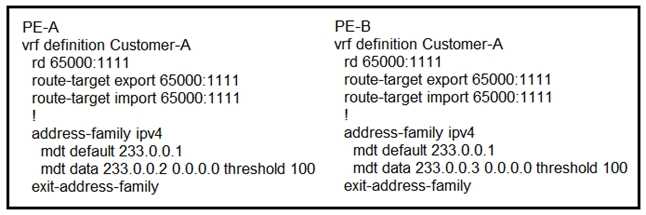
Which tree does multicast traffic follow?
- A. shared tree
- B. MDT default
- C. source tree
- D. MDT voice
Answer:
B
Question 2
Refer to the exhibit.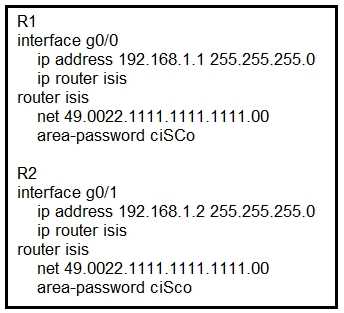
After you applied these configurations to routers R1 and R2, the two devices could not
form a neighbor relationship. Which reason for the problem is the most likely?
- A. The two routers cannot authenticate with one another.
- B. The two routers have the same area ID.
- C. The two routers have the same network ID.
- D. The two routers have different IS-types.
Answer:
C
Explanation:
For those asking about the password, area authentication doesn't prevent neighboring to come up
because it is carried only in LSP, CSNP and PSNP messages and not in IIH messages.
https://www.cisco.com/c/en/us/support/docs/ip/integrated-intermediate-system-to-intermediate-system-is-is/13792-isis-authent.html
Question 3
Refer to the exhibit.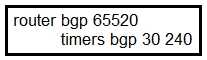
Which effect of this configuration is true?
- A. It sets the keepalive timer to 30 seconds and the hold timer to 240 seconds.
- B. It sets the keepalive timer to 30 milliseconds and the hold timer to 240 milliseconds
- C. It sets the hold timer to 30 milliseconds and the keepalive timer to 240 milliseconds
- D. It sets the hold timer to 30 seconds and the keepalive timer to 240 seconds
Answer:
A
Explanation:
Reference: https://www.cisco.com/c/en/us/td/docs/ios-xml/ios/iproute_bgp/command/irg-cr-
book/bgps1.
html#wp1552800140
Question 4
Refer to the exhibit.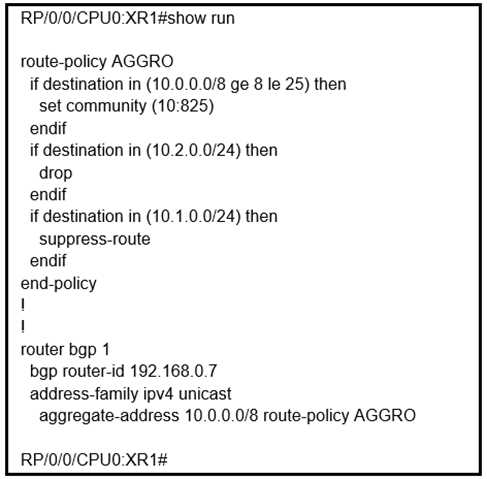
A network operator is working to filter routes from being advertised that are covered under
an aggregate announcement. The receiving router of the aggregate announcement block is still
getting some of the more specific routes plus the aggregate. Which configuration change ensures
that only the aggregate is announced now and in the future if other networks are to be added?
- A. Configure the summary-only keyword on the aggregate command
- B. Set each specific route in the AGGRO policy to drop instead of suppress-route
- C. Filter the routes on the receiving router
- D. Set each specific route in the AGGRO policy to remove instead of suppress-route
Answer:
A
Question 5
Refer to the exhibit.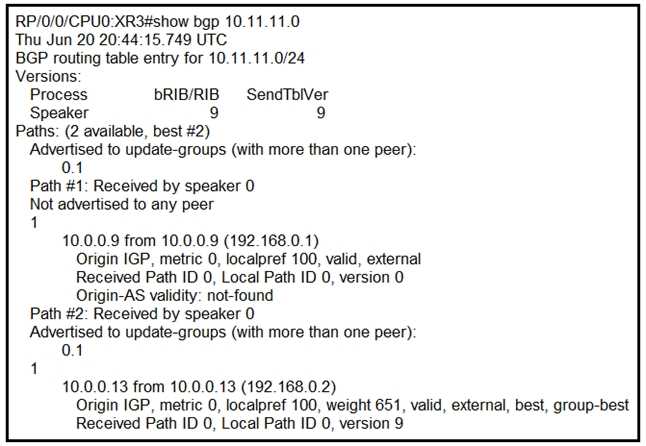
A network operator is getting the route for 10.11.11 0/24 from two upstream providers on
#XR3. The network operator must configure #XR3 to force the 10.11.11.0/24 prefix to route via next
hop of 10.0.0.9 as primary when available. Which of these can the operator use the routing policy
language for, to enforce this traffic forwarding path?
- A. weight of 0 on the prefix coming from 192.168.0.2
- B. lower local preference on the prefix coming from 192.168.0.2
- C. higher local preference on the prefix coming from 192.168.0.1
- D. weight of 100 on the prefix coming from 192.168.0.1
Answer:
A
Explanation:
Because Weight is the first attribute in path selection algorithm and is 0 for eBGP routes by default. If
we set it to 0, router will continue from weight to the bottom, and when comparing neighbor router
IDs it will find 192.168.0.1 less than 192.168.0.2 and st path will be selected as the best
Question 6
Refer to the exhibit.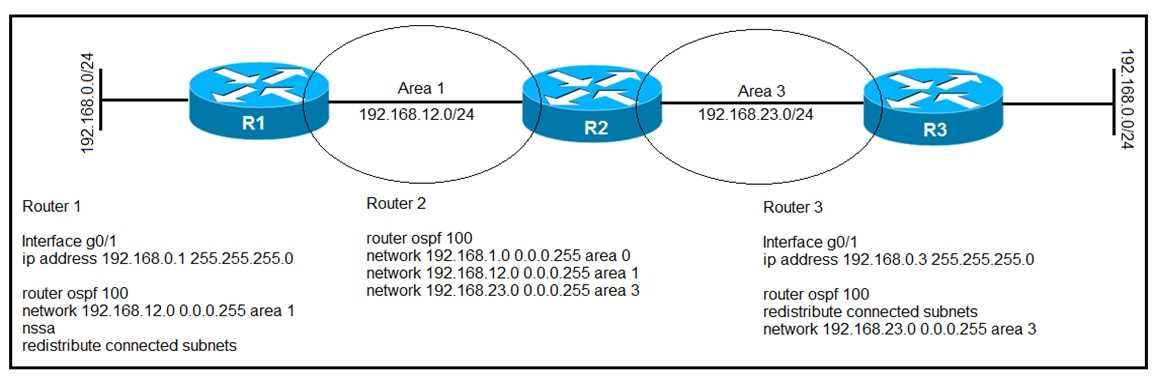
After troubleshooting an OSPF adjacency issue, routers 1, 2, and 3 have formed OSPF
neighbor relationships. Which statement about the configuration is true?
- A. Router 2 receives a Type 5 LSAs from router 1 for its connected subnets
- B. Router 2 uses router 3 as the next hop for 192.168.0.0/24
- C. Router 2 uses router 1 as the next hop for 192.168.0.0/24
- D. Router 2 receives a Type 7 LSAs from router 3 for its connected subnets
Answer:
C
Explanation:
From IOS 15.1(2)S onwards, Cisco uses the OSPF path selection order is O > O IA > N1 > E1 > N2 > E2
https://www.cisco.com/c/en/us/support/docs/ip/open-shortest-path-first-ospf/212608-ospf-external-path-selection-external-t.html
Question 7
DRAG DROP
Compare different features between OSPFv2 and OSPFv3. Drag and drop the descriptions of OSPF
from the left onto the correct OSPF versions on the right.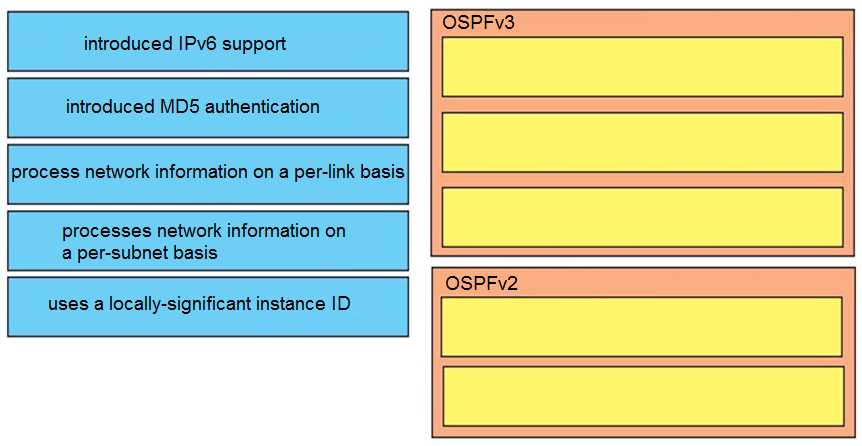
Answer:
Explanation: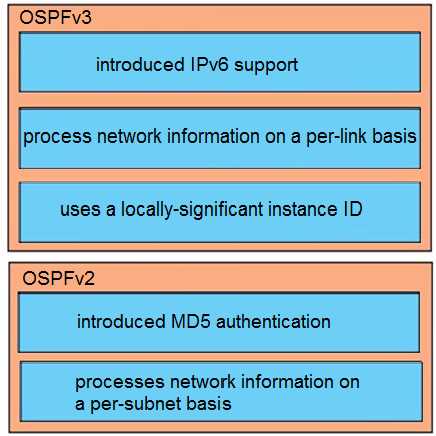
Question 8
A network consultant is troubleshooting IS-IS instances to identify why a routing domains is having
communication problems between the two instances. Which description of the possible cause of
issues in the routing domain is true?
- A. The same interface cannot be advertised in two different IS-IS instances
- B. The IS-IS “ISP” and “ISP2” instances are unrelated and unable to intercommunicate
- C. The configured IS-IS NSEL value is not allowing the routing systems to establish a neighborship
- D. The interface mode ip router is-is command was not included in the script
Answer:
A
Explanation:
Reference: https://www.cisco.com/c/en/us/td/docs/ios-xml/ios/iproute_isis/configuration/xe-3s/irs-xe-3s-book/irs-instance-vrf.html
Question 9
What is used by SR-TE to steer traffic through the network?
- A. shortest path calculated by IGP
- B. dynamic rules
- C. path policy
- D. explicit maps
Answer:
C
Explanation:
Reference: https://www.cisco.com/c/en/us/td/docs/routers/asr9000/software/segment-routing/configuration/guide/b-seg-routing-cg-asr9k/b-seg-routing-cg-asr9k_chapter_0100.html
Question 10
For which reason can two devices fail to establish an OSPF neighbor relationship?
- A. The two devices have different process IDs
- B. The two devices have different network types
- C. The two devices have different router IDs
- D. The two devices have the same area ID
Answer:
B
Explanation:
Reference: https://www.cisco.com/c/en/us/support/docs/ip/open-shortest-path-first-ospf/13699-29.html
Question 11
Refer to the exhibit.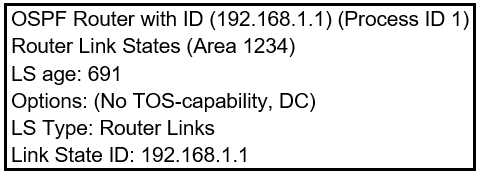
Which LSA type is indicated by this router output?
- A. type 3 LSA
- B. type 4 LSA
- C. type 1 LSA
- D. type 2 LSA
Answer:
C
Question 12
Which statement about enabling segment routing for IGPs is true?
- A. Segment routing must first be enabled under then routing process and then globally
- B. Segment routing must first be enabled globally and then under the routing process
- C. Segment routing can be enabled only under the routing process
- D. Segment routing can be enabled only globally
Answer:
B
Explanation:
Reference: https://www.cisco.com/c/en/us/td/docs/ios-xml/ios/seg_routing/configuration/xe-16-6/segrt-xe-16-6-book/sr-ospfv2-node-sid.html
Question 13
Which task is performed when troubleshooting LDP?
- A. Execute the ping utility to generate information about the MAC addresses used along the path
- B. Verify that MPLS is disabled globally and enabled on the necessary interfaces in a per-interface basis
- C. Execute the traceroute utility to generate information about the labels used along the path
- D. Verify that Cisco Express Forwarding has been disabled on the network
Answer:
C
Question 14
Refer to the exhibit.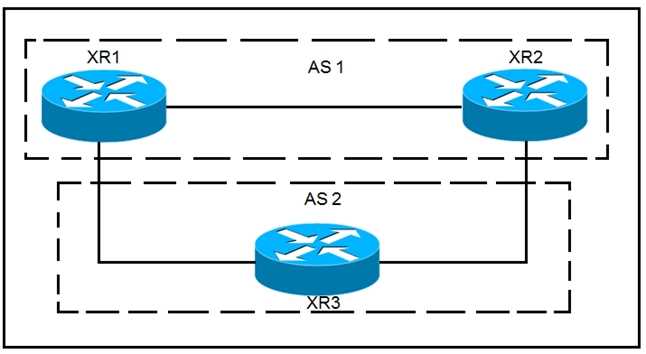
XR1 and XR2 are sending the prefix 10.11.11.0/24 to XR3. A configured policy on XR1 is
incorrectly prepending AS path 11 11 12 12 onto this prefix. A network operator wants to add a policy
onto XR3 that will not allow the falsely prepending prefix from being installed. Which policy
configuration applied to the XR3 neighbor configuration for XR1 can accomplish this requirement
without impact to other or future
received routes?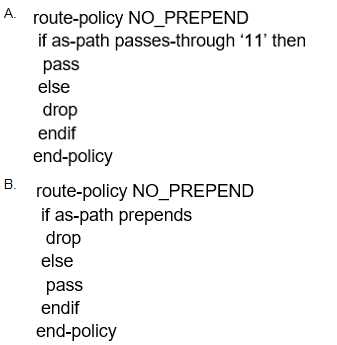
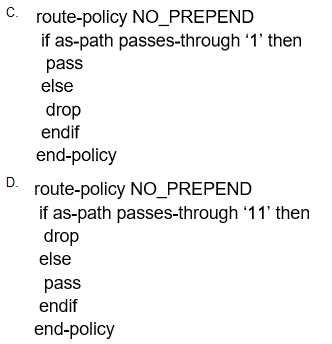
- A. Option A
- B. Option B
- C. Option C
- D. Option D
Answer:
D
Explanation:
Reference: https://www.cisco.com/c/en/us/td/docs/routers/crs/software/crs_r4-1/routing/command/reference/b_routing_cr41crs/b_routing_cr41crs_chapter_01000.html#wp3850885229
Question 15
Refer to the exhibit.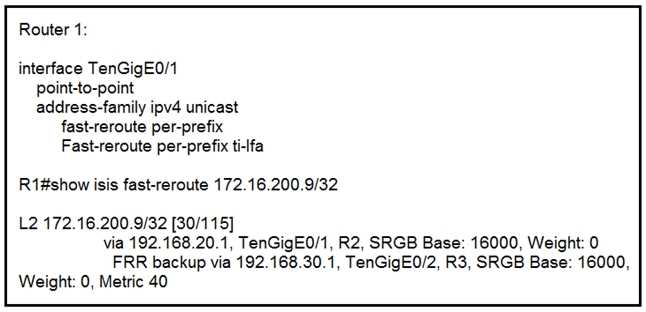
Router 1 is connected to router 2 on interface TenGigE0/1. Which interface provides the
alternate path to 172.16.200.9/32 when the link between router 1 and router 2 goes down?
- A. TenGigE0/1 interface provides the alternate path
- B. A backup path must be statically installed
- C. TenGigE0/2 interface provides the alternate path
- D. A primary path must be manually installed
Answer:
C