Laptops can communicate wirelessly, the phones need a wired connection. If only 42 devices need wired connections, 42/8=5.2 then 6 is the minimum required quantity of APs.
DRAG DROP
Drag and drop the characteristics from the left onto the correct functionalities on the right.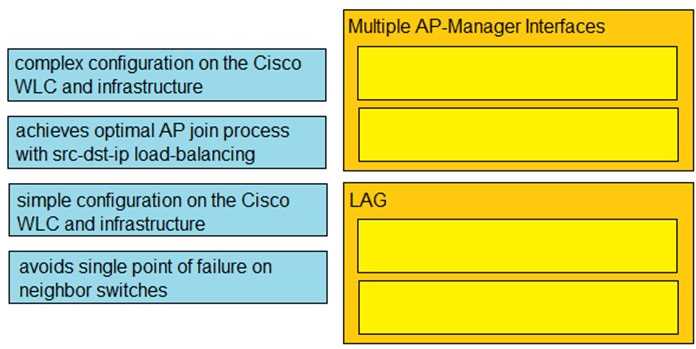
Explanation: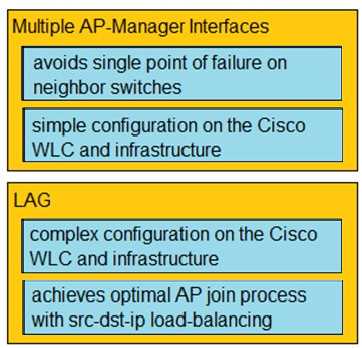
https://www.cisco.com/c/en/us/td/docs/wireless/controller/7-4/configuration/guides/consolidated/b_cg74_CONSOLIDATED/b_cg74_CONSOLIDATED_chapter_010100001.html
Which UDP port numbers are used for exchange mobility packets in an AireOS wireless deployment?
A
Explanation: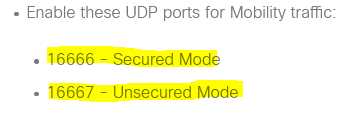
A customer asks an engineer to explain the concept of mobility domains and mobility groups. Which
statement does the engineer respond with?
C
Explanation:
Mobility domains and mobility groups are concepts used in Cisco wireless networking to manage
client roaming and controller interaction. When Wireless LAN Controllers (WLCs) are part of the
same mobility domain, they share a common database, allowing them to communicate and facilitate
seamless client roaming. A mobility group is a subset of this domain, where specific WLCs work
together more closely to share client context and security credentials. This ensures that when a client
roams from one access point (AP) to another across different controllers, the authentication and
security context are maintained, allowing for a seamless transition without the need to re-
authenticate. The mobility group also manages AP fail-over between controllers, ensuring clients can
maintain their connections even if their current AP fails or becomes unreachable.
https://www.cisco.com/c/en/us/td/docs/wireless/controller/8-0/configuration-guide/b_cg80/b_cg80_chapter_010011.html
An engineer is designing a wireless deployment for a university auditorium. Which two features can
be used to help deal with the issues introduced by high AP count? (Choose two.)
B,C
Explanation:
RXSOP (Receive Start of Packet Detection Threshold) and TPC (Transmit Power Control) are two
features that can help manage the challenges associated with a high AP (Access Point) count in a
dense environment like a university auditorium. RXSOP can be adjusted to refine how APs
differentiate between noise and valid packets, which is particularly useful in high-density areas
where multiple APs might otherwise respond to the same signal. TPC helps in managing the transmit
power of APs, allowing for better coverage and reduced interference among APs that are in close
proximity to each other. Reference: Designing Cisco Enterprise Wireless Networks (ENWLSD 300-425)
https://www.cisco.com/c/en/us/support/docs/wireless-mobility/80211/200069-Overview-on-802-11h-Transmit-Power-Cont.html
A wireless engineer is designing a wireless network to support real-time applications over wireless.
Which IEEE protocol must the engineer enables on the WLC so that the number of packets that are
exchanged between an access point and client are reduced and fast roaming occurs?
B
Explanation:
The IEEE 802.11r protocol, also known as Fast BSS Transition (FT), is designed to support real-time
applications by enabling faster roaming between APs. This protocol reduces the number of packets
exchanged during the reauthentication process when a client moves from one AP to another, thus
ensuring a more seamless transition and maintaining the quality of service required by real-time
applications such as voice and video conferencing. Reference: Designing Cisco Enterprise Wireless
Networks (ENWLSD 300-425)
A network administrator of a global organization is collapsing all controllers to a single cluster
located in central Europe. Which concern must addressed?
A
Explanation:
When collapsing all controllers to a single cluster in a central location, one must consider the
availability of channels across different regions. Regulatory domains vary globally, and certain
channels allowed in Europe may not be available or legal in other parts of the world. This can affect
the consistency of wireless coverage and performance.
https://www.cisco.com/c/en/us/td/docs/wireless/controller/technotes/86/b_Cisco_Wireless_LAN_Controller_Configuration_Best_Practices.html
An engineer must ensure that the new wireless LAN deployment can support seamless roaming
between access points using a standard based on an amendment to the 802.11 protocol. Which
protocol must the engineer selects?
C
Explanation:
For seamless roaming between access points, the protocol that supports fast transitions is 802.11r.
This amendment to the 802.11 standard allows devices to roam quickly by establishing security
credentials before moving to the next access point, reducing the time required for reauthentication.
A high-density wireless network is designed. Which Cisco WLC configuration setting must be
incorporated in the design to encourage clients to use the 5 GHz spectrum?
A
Explanation:
: Band Select is a feature on Cisco Wireless LAN Controllers (WLC) that encourages dual-band
wireless clients to connect to the less congested 5 GHz band. This helps to balance the client load
between 2.4 GHz and 5 GHz and improve overall network performance in high-density
environments.
Reference: Look for information on ‘Band Select’ in the official Cisco ENWLSD 300-425 certification
guide.
A network engineer is preparing for an office site survey with a height of 2.5 meters. Which three
components are recommended to complete the survey? (Choose three.)
A,B,F
Explanation:
For an effective office site survey, it’s recommended to: A. Use a battery pack to power APs - This
allows for mobility and testing in various locations without relying on fixed power sources. B. Use a
drawing of the office space to mark AP and client placements - This helps in planning the optimal
locations for AP installation. F. Use APs with built-in antennas - They are commonly used for site
surveys as they represent the typical deployment scenario.
Reference: The official Cisco ENWLSD 300-425 certification guide will have more details on
conducting site surveys.
https://www.cisco.com/c/en/us/td/docs/wireless/technology/mesh/8-4/b_mesh_84/Site_Preparation_and_Planning.html#ID3405
A wireless engineer must optimize RF performance for multiple buildings with multiple types of
construction and user density. Which two actions must be taken? (Choose two.)
C,D
Explanation:
To optimize RF performance across different buildings and user densities: C. Configure AP groups for
each area type - This allows for customized settings for APs serving different areas. D. Configure RF
profiles for each area type - RF profiles enable the customization of RF parameters to suit the specific
needs of each building or area type.
Reference: The official Cisco ENWLSD 300-425 certification guide will provide more information on
RF optimization strategies.
https://www.cisco.com/c/en/us/td/docs/wireless/controller/8-10/config-guide/b_cg810/configuring_ap_groups.html
A wireless engineer is hired to design a network for a technology company. The company campus has
four buildings and a warehouse with access points that provide full wireless coverage as well as a
pair of WLCs located in the core of the network. Which type of wireless architecture is being used?
C
Explanation:
The wireless architecture described is a centralized deployment. This is characterized by access
points distributed across multiple buildings and managed centrally by Wireless LAN Controllers
(WLCs). Centralized deployments are common in larger environments like a technology company
campus because they allow for centralized management, scalability, and advanced features such as
load balancing and fault tolerance.
Reference:
CCNP Enterprise Wireless Design ENWLSD 300-425 and Implementation ENWLSI 300-430 Official
Cert Guide Premium Edition and Practice Tests
Refer to the exhibit.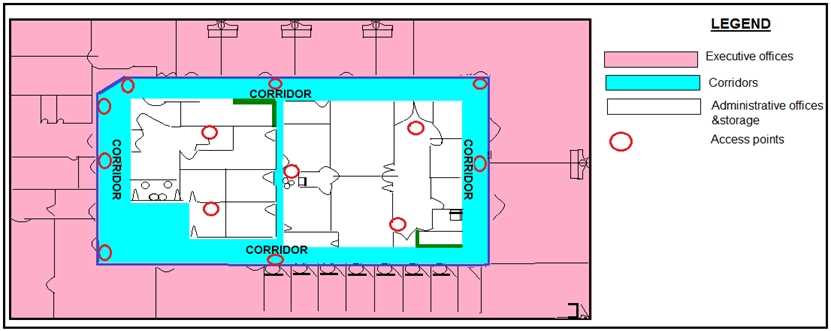
What is the main reason why the Wi-Fi design engineer took a different approach than installing the
APs in the offices, even though that installation provides better coverage?
B
Explanation:
The decision to avoid installing APs directly in offices is likely due to transmit power considerations.
Placing APs within offices could lead to excessive coverage for small areas, causing interference with
other APs and reducing overall network performance. By placing them in common areas like
corridors, engineers can ensure more uniform coverage across larger spaces while managing
transmit power more effectively for optimal performance.
Reference:
CCNP Enterprise Wireless Design ENWLSD 300-425 Official Cert Guide
https://www.cisco.com/en/US/docs/solutions/Enterprise/Mobility/emob30dg/RFDesign.html#wp10
00551
Where must the APs be mounted when used in a high-density wireless network to provide 6 dB to 20
dB of attenuation to a cell?
B
Explanation:
In high-density environments, such as stadiums or auditoriums, APs are often mounted under the
seats to provide a controlled cell size with attenuation. This placement helps to manage the RF
environment by providing attenuation of 6 dB to 20 dB, which can reduce co-channel interference
and improve the user experience by ensuring a strong signal and minimizing noise from other cells.
A company wants to replace its existing PBX system with a new VoIP System that will include wireless
IP phones. The CIO has concerns about whether the company’s existing wireless network can
support the new system. Which tool in Cisco Prime can help ensure that the current network will
support the new phone system?
D
Explanation:
The Voice Readiness tool within Cisco Prime Infrastructure is designed to assess the wireless
network’s ability to support voice services, including VoIP. It evaluates various factors such as signal
strength, noise levels, and coverage to ensure that the wireless network can handle the quality of
service requirements needed for voice communications.
A rapidly expanding company has tasked their network engineer with wirelessly connecting a new
cubicle area with Cisco workgroup bridges until the wired network is complete. Each of 42 new users
has a computer and VoIP phone. How many APs for workgroup bridging must be ordered to keep
cost at a minimum while connecting all devices?
C
Explanation:
Cisco workgroup bridges typically support up to 8 wired clients. With 42 users, each having a
computer and a VoIP phone, that’s a total of 84 devices. To connect all devices while keeping costs at
a minimum, the company would need 6 APs (as 7 x 12 = 84), with each AP supporting 14 devices (7
computers and 7 VoIP phones).
So, each AP will have 25 clients. Minimum 4 APs are sufficient.
Laptops can communicate wirelessly, the phones need a wired connection. If only 42 devices need wired connections, 42/8=5.2 then 6 is the minimum required quantity of APs.