cima cimapro19 p03 1 practice test
P3 Risk Management
Question 1
The Committee of Sponsoring Organisations (COSO) outlined six key principles of Enterprise Risk
Management (ERM).
Which of the following are COSO key principles?
- A. The creation of a risk aware culture.
- B. A comprehensive and holistic approach to risk management.
- C. Risk management is the responsibility of the risk committee.
- D. Consideration of risk management in the context of business strategy.
- E. Consideration of the main risk only which is financial risk.
Answer:
A, B, D
Question 2
DRAG DROP
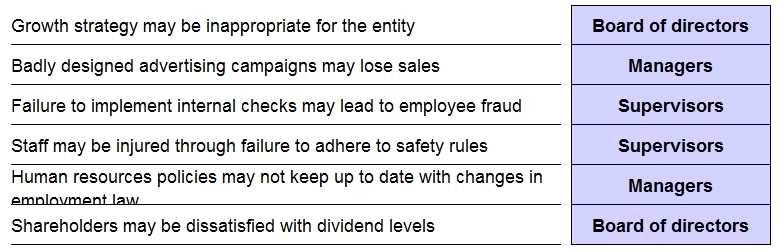
Select the most appropriate level of responsibility for managing each of the following risks.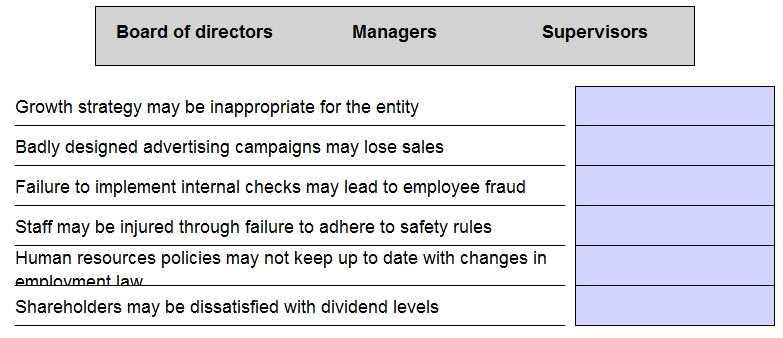
Answer:
Question 3
K Ltd is an on-line travel agency specialising in budget package holidays to a small number of popular
locations. The holidays that it sells are made up of a "package" of flights, hotel accommodation and
food. K Ltd's Finance Director is concerned that the company's scope of operation is too narrow and
wishes to diversify.
Identify TWO actions that K Ltd should take immediately.
- A. Set up a number of activity holidays; adventure, sports and trekking for example.
- B. Bulk book cruise accommodation and create a special package deal for retired couples.
- C. Expand the number of locations it currently serves.
- D. Re-image the locations it currently serves to make them more exotic and family friendly.
- E. Review the customer base looking at feedback, repeat sales and single visit statistics.
- F. Engage market researchers to look at future trends in holiday requirements.
Answer:
E, F
Question 4
Which of the following statements are correct?
- A. It is always possible to remove all risks when undertaking large projects.
- B. If a project has high risks it should always be accepted as the rewards will always be high.
- C. If a project has low risks it will usually have relatively low returns.
- D. Risk can always be transferred to someone else.
- E. Risk should be carefully considered when evaluating possible future projects.
Answer:
C, E
Question 5
A hospital is part of a government provided health service which is free to patients. The
management of the hospital is concerned with the need to minimise the risks to which the hospital is
exposed from patient litigation.
In this context, which TWO of the following are appropriate steps to manage this risk?
- A. Ensuring that patients undergoing procedures sign documentation to confirm that the risks have been explained to them and that they understand.
- B. Allocating a risk score to patients depending on age, general heath and similar consideration and refusing to admit patients whose risk score exceeds a certain threshold.
- C. Ensuring that a policy is in place to transfer or discharge critically ill patients so as to minimise fatalities in the hospital.
- D. Ensure that proper documentation is in place for all patients showing such details as symptoms, treatments, and test results.
- E. The management refuses to allow the hospital to participate in the Major Accident Plan for the city in which it is located. It believes the Plan could expose the hospital to excessive risk.
Answer:
A, D
Question 6
D is a large oil refinery.
The managers have identified four risks shown in the risk map below:
Which of the risk mitigations listed below would be the best for dealing with the two risks classified
as medium likelihood and high impact?
- A. Accept
- B. Reduce
- C. Transfer
- D. Avoid
Answer:
C
Question 7
Which of the following are true of an effective risk management culture?
- A. Staff should be penalised for being associated with negative events.
- B. All risk should be eliminated.
- C. Responsibility for risk management should be devolved to a risk manager.
- D. All staff should be aware of risks affecting the entity.
- E. Risk management should be regarded as part of the overall business strategy.
- F. The directors should take an active interest in risk management.
Answer:
D, E, F
Question 8
The safety guard on a piece of equipment was broken. The factory manager suspended an operator
who refused to operate the equipment until it was repaired. The factory manager paid another
operator a bonus for operating the damaged equipment until the safety guard could be repaired.
What does this incident say about the control environment within that factory?
- A. Management is not particularly concerned with managing risks.
- B. Employees will perceive that management does not care about health and safety risks.
- C. This factory's safety record is likely to be poor.
- D. Employees are motivated to maintain productivity.
- E. Management has a proportionate and considered attitude towards risk.
Answer:
A, B, C
Question 9
K is a large mining company. In its risk report it states that there is a risk of accidents and injury
because of the nature of the industry. It states that it has staff training in place and complies with
all Health and Safety regulations but in spite of this there will still be a residual risk that accidents
and injuries may occur.
Which of the following statements are correct?
- A. The shareholders should not invest because there is still a residual risk.
- B. The directors are avoiding their responsibilities by saying there is a residual risk.
- C. Some risks cannot be eliminated.
- D. Accepting a residual risk does not imply the company is reckless.
- E. Most companies in this industry will say something similar in their risk report.
Answer:
C, D, E
Question 10
P Ltd manufactures and sells electrical goods through retail outlets.
N is P Ltd's Sales Director. He has been recently promoted from a senior sales position with P Ltd. He
has been forced to spend the first six months as Sales Director on dealing with an administrative
mess left behind by the previous sales director.
You are a Senior Management Accountant at P Ltd. You have worked with N for many years.
N has worked hard and has made many changes that have brought significant benefit to the
business.
N has asked you to postpone the recording of some purchase invoices so that he will meet his
quarterly targets on profit margin.
What should you do?
- A. Collect all the facts, distance yourself from the situation but say nothing.
- B. Write up the facts of the issue and put it on your files.
- C. Document the situation and present the facts to your manager.
- D. Do nothing, no rules have been broken, tell N that you cannot do as he asks and that he needs to abide by the professional codes.
Answer:
D
Question 11
DRAG DROP
V buys vegetables and fruit from three farms located in a different part of V's country and sells them
to large supermarket chains.
A recent newspaper magazine had an article on these farms showing that the farms employ illegal
immigrants whose status was used by the factory's owners to force them to work for low wages and
in unpleasant conditions. They are forced to live in small overcrowded caravans with no running
water. They are also given meals which are cold and poor quality. These farms are located in a
developed country with strong labour laws.
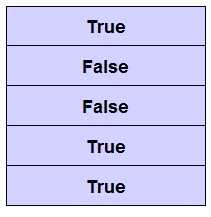
Classify each of the following statements as true or false.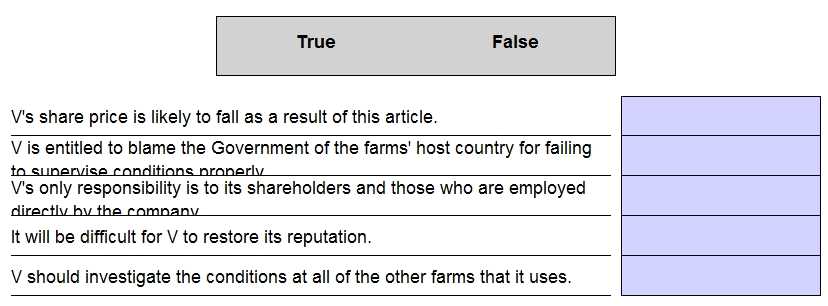
Answer:
Question 12
W is a construction company which undertakes large projects for governments and other clients
worldwide. Following extensive tendering processes, contracts are issued for successful tenders, and
projects typically take three to five years to complete. Contracts are normally fixed-price and many
have considerable penalty clauses.
Which of the following would be appropriate policies and controls for W to implement?
- A. Unsuccessful tenders should be analysed to establish the cause of them failing to be awarded the work and help to avoid future failures.
- B. Ensuring a consistent separation of duties between those involved in the preparation of tenders and those involved in the planning of projects.
- C. Ensuring that the minimum legal wage is paid to all workers on the construction sites.
- D. In order to ensure the maximum chance of winning the contract, tenders always commit W to completing the work at the lowest possible price and in the shortest possible time.
- E. Contract terms should be worded precisely so that additional work is not deemed to form part of the contract.
- F. The project steering committee and project board should receive regular project status reports.
Answer:
A, E, F
Question 13
DRAG DROP
H sells machinery and also associated services, such as advice and repairs. H's industry is going
through considerable transformation.
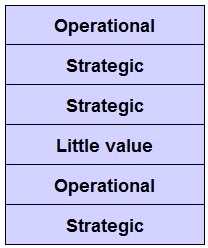
Classify each of the examples of information available to H's management as strategic, operational or
of having little value.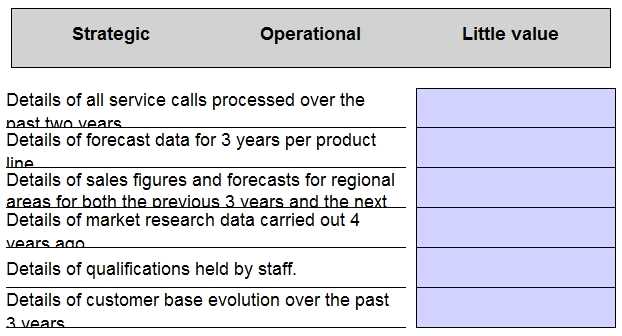
Answer:
Question 14
H Ltd is a company providing postal and courier services to small businesses. Customers pay a
monthly or annual subscription fee to use the service, plus a very small fee for each item delivered.
A year ago, H employed a new sales team. Their remuneration is dependent on the number of new
customers they sign up. Sales increased dramatically in the first six months, but now difficulties are
emerging such as new customers dropping their subscription once the initial period has expired;
subscriber direct debits being returned unpaid; subscribers going out of business and other similar
issues.
Which of the following would be appropriate to help resolve these problems?
- A. Alter the pricing structure in order to increase the price for sending each item but decrease the subscription element of the fee.
- B. Ensure that a credit check is carried out before a subscriber is accepted.
- C. Reduce the rate of commission payable to any sales person who fails to sign up at least an agreed minimum number of customers each month.
- D. Alter the commission arrangements so that commission is payable only when the subscriber signs up for a second year.
- E. Preparing a monthly report for sales persons detailing the performance of each new customer they have signed up over the previous year.
Answer:
B, D, E
Question 15
M plc is an IT company that bids for large contracts to sell computer systems and also to
service existing systems. M plc's senior management has always set budgets which are hard to
achieve and have made no allowances for the recession.
The economy has improved and M plc's senior managers have made the budget even more
optimistic. The budgeted sales target has been increased by 40%.
In the past, sales staff have not tried to achieve the budget sales because it was generally believed
that the targets were impossible to reach.
M plc has recently appointed a new Sales Director who has decided that sales staff will
be dismissed if they fail to meet sales targets for three successive months. He is also looking
for higher sales margins than were achieved before.
What are the likely consequences of the new Sales Director's policy?
- A. Sales staff will be happier in their jobs.
- B. Sales staff will tender for riskier contracts.
- C. Sales staff will encroach on other sales staff territories to get more work.
- D. Sales staff will look for new jobs.
- E. Sales staff will feel more settled and secure in their jobs.
Answer:
B, C, D