alfresco acsce-5x practice test
Alfresco Content Services Certified Engineer
Question 1
How should s be identified and recognized?
- A. Smart Folders should be recognized by their type smf:smartFolder
- B. Smart Folders should be recognized by parent-child type used smf:contains
- C. Smart Folders should be recognized by their aspect smf:smartFolder
- D. Smart Folders should be recognized by the special node reference used.
- E. Smart Folders cannot be recognized as they are not different from any other cm:folder.
Answer:
D
Explanation:
References:
https://docs.alfresco.com/6.0/references/sf-tech-faqs.html
Question 2
If an object is moved to a different folder, what will happen to the node’s security permissions?
- A. It will inherit the ACL from the new parent folder.
- B. It will inherit the ACL from the user who is moving it.
- C. It will inherit the system wide ACL.
- D. It will keep its old ACL.
Answer:
A
Question 3
Which of the following is not an Alfresco-supplied subsystem category?
- A. Dictionary.
- B. Authentication.
- C. Audit.
- D. Search.
Answer:
A
Explanation:
References:
https://docs.alfresco.com/community5.0/concepts/subsystem-categories.html
Question 4
When testing an Alfresco Content Services extension under high levels of concurrency, you notice
that some transactions are failing due to locking issues with the database. What is an appropriate
way to resolve this?
- A. Manually unlock the offending records and start the testing again.
- B. Directly use Alfresco’s database connection pool and write your own SQL.
- C. Use the RetryingTransactionHelper to retry code that fails due to locking.
- D. Rewrite the queries used by your application to reduce the chance of the lock.
Answer:
A
Question 5
What does it mean when it is said in Solr indexing that the index is “eventually consistent”?
- A. The index will only be consistent after a server restart.
- B. The index will become consistent when there are no more transactions to index.
- C. The index becomes consistent once a day when the index job runs.
- D. The index can only be consistent when the Lucene index job eventually runs.
Answer:
B
Question 6
You have been tasked to develop a solution that will notify an external system when updates are
made to certain documents. These documents can be of any type and the content authors will make
the decision if the document needs this “notification” functionality. Select the simplest combination
steps that will implement this solution.
- A. Define a new “notify” aspect with a “multi” peer association. Create and register a policy behavior that, when content is updates, users can associate their content via this aspect. As associations are being made, the external notification request will be triggered.
- B. Define a new “notify” aspect with no properties. Create and register a policy behavior that, if this aspect is present, will make the external notification request. Users can simply add this aspect to their content item.
- C. Extend cm:content to provide an additional “notify” property. Create a policy behavior that will look at the “notify” property and, if set, make the external notification request. Users simply create cm:content items.
- D. Extend sys:base to provide an additional “notify” property. Create a new policy that will look at the “notify” property and, if set, make the external notification request. Users can simply call an action against their content item.
Answer:
A
Question 7
Which tasks would require a restart of the Alfresco server to apply the changes? (Choose two.)
- A. Deploying a new content model via a *-context.xml file.
- B. Deploying a new content model into Data Dictionary/Models.
- C. Deploying a new workflow through the Activiti workflow console.
- D. Making configuration changes in alfresco-global properties.
- E. Making configuration changes via JMX.
Answer:
A,D
Question 8
Select the element that will allow any node to be included as part of a peer association:
- A. <target><class>d:noderef</class></target>
- B. <target><class>ANY</class></target>
- C. <target><class>sys:base</class></target>
- D. <target><class>cm:cmobject</class></target>
Answer:
C
Question 9
Which one of the following statements about aspects is TRUE?
- A. Aspects can only be applied to “cm:content”.
- B. An aspect can have a type as a parent.
- C. An aspect may not include associations.
- D. Aspects can inherit from other aspects.
Answer:
B
Question 10
Which file is required in order for an AMP file to be valid?
- A. module.properties
- B. service-context.xml
- C. file-mapping.properties
- D. web.xml
Answer:
A
Question 11
Select two ways to audit Alfresco Content Services events in an Alfresco Content Services extension?
(Choose two.)
- A. Mark a method in the extension with an @Auditable annotation.
- B. Open a connection to the database and write the audit information to the audit tables.
- C. Inject AuditComponent into the extension and call recordAuditValues.
- D. Use the Alfresco REST API to record an audit event.
- E. Call the Java Audit Service.
Answer:
D,E
Explanation:
References:
http://docs.alfresco.com/6.0/concepts/audit-intro.html
Question 12
The workflow pictured, shows 3 gateways. What type of gateways are they?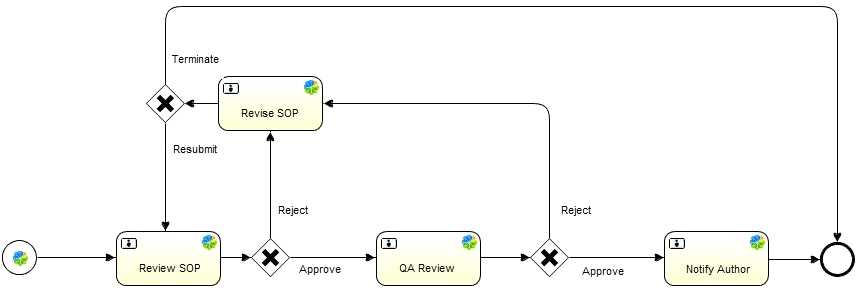
- A. Exclusive
- B. Parallel
- C. Inclusive
- D. Fork
- E. Join
Answer:
A
Explanation:
References:
http://docs.alfresco.com/process-services1.9/topics/exclusive_gateway.html
Question 13
To which content model entities can a behavior be associated with? (Choose two.)
- A. Aspects.
- B. Types.
- C. Constraints.
- D. Rules.
- E. Associations.
Answer:
A,B
Question 14
What is Alfresco’s preferred tool for building and packaging an extension?
- A. Winzip
- B. Ant
- C. Maven
- D. Gradle
Answer:
C
Explanation:
References:
https://community.alfresco.com/docs/DOC-4967-packaging-and-deploying-extensions
Question 15
A scheduled job can execute a piece of logic either by itself or wrapped inside a repository action.
What is the benefit of defining a template action for the scheduled job?
- A. The job can execute a logic that is not related specifically to a node.
- B. The job can execute a logic multiple times, once for each node returned by a query.
- C. The job can execute a logic only once and does a mass update of nodes returned by a query.
- D. The job can execute a logic multiple times on the same specific node.
Answer:
D