aicpa cpa-auditing practice test
CPA Auditing and Attestation
Question 1
Several sources of GAAP consulted by an auditor are in conflict as to the application of an accounting
principle. Which of the following should the auditor consider the most authoritative?
- A. FASB Technical Bulletins.
- B. AICPA Accounting Interpretations.
- C. FASB Statements of Financial Accounting Concepts.
- D. AICPA Technical Practice Aids.
Answer:
A
Explanation: :
Choice "a" is correct. In accordance with the GAAP hierarchy, FASB Technical Bulletins are considered
the most authoritative of the sources listed in the question.
Choice "b" is incorrect. Of the sources listed, AICPA Accounting Interpretations would be considered
the second most authoritative.
Choice "c" is incorrect. FASB Statements of Financial Accounting Concepts are among the least
authoritative sources of GAAP available to auditors.
Choice "d" is incorrect. AICPA Technical Practice Aids are among the least authoritative sources of
GAAP available to auditors.
Question 2
For an entity's financial statements to be presented fairly in conformity with generally accepted
accounting principles, the principles selected should:
- A. Be applied on a basis consistent with those followed in the prior year.
- B. Be approved by the Auditing Standards Board or the appropriate industry subcommittee.
- C. Reflect transactions in a manner that presents the financial statements within a range of acceptable limits.
- D. Match the principles used by most other entities within the entity's particular industry.
Answer:
C
Explanation:
Choice "c" is correct. Financial statements are presented fairly in conformity with GAAP when there
are no material misstatements included therein. The fact that there may occasionally be immaterial
misstatements means that the financial statements are correct "within a range of acceptable limits."
Choice "a" is incorrect. Accounting principles may change from year to year. As long as such changes
are properly accounted for, the financial statements are still in conformity with GAAP.
Choice "b" is incorrect. The AICPA and the FASB determine GAAP, not the Auditing Standards Board.
Choice "d" is incorrect. There is no requirement that an entity's financial statements be prepared in
accordance with prevalent industry practices in order to be in conformity with GAAP.
Question 3
Which of the following statements is correct concerning an auditor's responsibilities regarding
financial statements?
- A. An auditor may not draft an entity's financial statements based on information from management's accounting system.
- B. The adoption of sound accounting policies is an implicit part of an auditor's responsibilities.
- C. An auditor's responsibilities for audited financial statements are confined to the expression of the auditor's opinion.
- D. Making suggestions that are adopted about an entity's internal control environment impairs an auditor's independence.
Answer:
C
Explanation:
Choice "c" is correct. An auditor's responsibility is to express an opinion on financial statements
based on an audit.
Choice "a" is incorrect. An auditor may draft an entity's financial statements based on information
from management's financial system. This would be referred to as a compilation engagement.
Choice "b" is incorrect. The adoption of sound accounting policies is an implicit part of
management's responsibilities, not the auditor's responsibilities.
Choice "d" is incorrect. An auditor often makes suggestions that are adopted about an entity's
internal control environment.
Professional Standards
Question 4
Which of the following provides the most authoritative guidance for an auditor?
- A. An AICPA audit and accounting guide that provides specific guidance with respect to the accounting practices in the client's industry.
- B. A Journal of Accountancy article discussing implementation of a new standard.
- C. General guidance provided by a Statement on Auditing Standards.
- D. Specific guidance provided by an interpretation of a Statement on Auditing Standards.
Answer:
C
Explanation:
Choice "c" is correct. General guidance provided by a Statement on Auditing Standards is the most
authoritative of level of auditing guidance. Auditors are required to comply with SASs, and should be
prepared to justify any departures therefrom.
Choices "a" and "d" are incorrect. AICPA audit and accounting guides and SAS interpretations are
interpretive publications that provide guidance regarding how SASs should be applied in specific
situations. They are not as authoritative as SASs.
Choice "b" is incorrect. Journal of Accountancy articles have no authoritative status but may be
helpful to the auditor.
Question 5
Which of the following accurately depicts the auditor's responsibility with respect to Statements on
Auditing Standards?
- A. The auditor is required to follow the guidance provided by the Standards, without exception.
- B. The auditor is generally required to follow the guidance provided by Standards with which he or she is familiar, but will not be held responsible for departing from provisions of which he or she was unaware.
- C. The auditor is generally required to follow the guidance provided by the Standards, unless following such guidance would result in an audit that is not cost-effective.
- D. The auditor is generally required to follow the guidance provided by the Standards, and should be able to justify any departures.
Answer:
D
Explanation:
Choice "d" is correct. The auditor is generally required to follow the guidance provided by the
Standards, and should be able to justify any departures.
Choice "a" is incorrect. On rare occasions, the auditor may depart from the guidance provided by the
SASs, but he or she must justify such departures.
Choice "b" is incorrect. Lack of familiarity with a SAS is not a valid reason for departing from its
guidance.
The auditor is expected to have sufficient knowledge of the SASs to identify those that are applicable
to a given audit engagement.
Choice "c" is incorrect. The cost associated with following the guidance provided by a SAS is not an
acceptable reason for departing from its guidance.
Question 6
In the first audit of a new client, an auditor was able to extend auditing procedures to gather
sufficient evidence about consistency. Under these circumstances, the auditor should:
- A. Not report on the client's income statement.
- B. Not refer to consistency in the auditor's report.
- C. State that the consistency standard does not apply.
- D. State that the accounting principles have been applied consistently.
Answer:
B
Explanation:
Choice "b" is correct. The auditor's standard report implies that the auditor is satisfied that the
comparability of financial statements between periods has not been materially affected by changes
in accounting principles and that such principles have been consistently applied between or among
periods.
Since the auditor has gathered sufficient evidence about consistency, no reference need be made in
the report.
Choice "a" is incorrect. If the auditor is able to obtain sufficient evidence about consistency, the
auditor may report on the entity's financial statements.
Choice "c" is incorrect. The consistency standard is one of the ten GAAS, and it does apply to this
audit.
Choice "d" is incorrect. If the auditor is able to obtain sufficient evidence about consistency, no
mention of consistency need be made. Consistency is implied in the standard report.
Question 7
The third general standard states that due care is to be exercised in the performance of an audit. This
standard is ordinarily interpreted to require:
- A. Thorough review of the existing safeguards over access to assets and records.
- B. Limited review of the indications of employee fraud and illegal acts.
- C. Objective review of the adequacy of the technical training and proficiency of firm personnel.
- D. Critical review of the judgment exercised at every level of supervision.
Answer:
D
Explanation:
Choice "d" is correct. The third general standard of due care is ordinarily interpreted to require
critical review of the judgment exercised at every level of supervision, and the judgment exercised by
those assisting in the audit.
Choice "a" is incorrect. The third general standard of due care does not require a thorough review of
the existing safeguards over access to assets and records.
Choice "b" is incorrect. The standard of due care does not specifically require a limited review of the
indications of employee fraud and illegal acts.
Choice "c" is incorrect. The standard of due care does not require a review of audit staff training and
proficiency.
Question 8
The concept of materiality would be least important to an auditor when considering the:
- A. Adequacy of disclosure of a client's illegal act.
- B. Discovery of weaknesses in a client's internal control.
- C. Effects of a direct financial interest in the client on the CPA's independence.
- D. Decision whether to use positive or negative confirmations of accounts receivable.
Answer:
C
Explanation:
Choice "c" is correct. Any direct financial interest in a client impairs independence, even if it is
immaterial.
Choice "a" is incorrect. A material illegal act may require disclosure in or adjustment to the financial
statements, whereas an immaterial illegal act may not require disclosure.
Choice "b" is incorrect. A material weakness in internal control will affect the nature, timing, and
extent of audit procedures, whereas an immaterial weakness in internal control may have little
impact on the audit.
Choice "d" is incorrect. An auditor is likely to use positive confirmations for material accounts
receivable, but may consider negative confirmations for immaterial receivable balances.
Question 9
An auditor of a nonpublic company must conduct the audit in accordance with:
I. ASB standards.
II. PCAOB standards.
- A. I.
- B. Both I and II.
- C. Either I or II, but not both.
- D. II.
Answer:
A
Explanation:
Choice "a" is correct. An auditor of a nonpublic company must conduct the audit in accordance with
ASB standards.
Choice "b" is incorrect. An auditor of a nonpublic company is not required to conduct the audit in
accordance with PCAOB standards.
Choice "c" is incorrect. While an auditor is only required to conduct the audit in accordance with ASB
standards, the auditor may choose to follow PCAOB standards as well.
Choice "d" is incorrect. An auditor of a nonpublic company is not required to conduct the audit in
accordance with PCAOB standards.
Question 10
Because of the risk of material misstatement, an audit of financial statements in accordance with
generally accepted auditing standards should be planned and performed with an attitude of:
- A. Objective judgment.
- B. Independent integrity.
- C. Professional skepticism.
- D. Impartial conservatism.
Answer:
C
Explanation:
Choice "c" is correct. The auditor should plan and perform the audit with an attitude of professional
skepticism. This attitude includes a questioning mind and a critical assessment of audit evidence.
Choices "a", "b", and "d" are incorrect. Objectivity, independence, integrity, and impartiality are basic
ethical characteristics and professional qualities embodied in the general standards.
Question 11
Which of the following is not an example of the application of professional skepticism?
- A. Designing additional auditing procedures to obtain more reliable evidence in support of a particular financial statement assertion.
Answer:
C
B. Obtaining corroboration of management's Explanation: s through consultation with a specialist.
C. Inquiring of prior year engagement personnel regarding their assessment of management's
honesty and integrity.
D. Using third party confirmations to provide support for management's representations.
Answer: C
Explanation:
Choice "c" is correct. The auditor should consider that fraud might occur regardless of any past
experience with the entity. An assessment of management's honesty and integrity performed during
the previous year would not necessarily be relevant to the current year's audit.
Choice "a" is incorrect. An auditor might apply professional skepticism by performing additional
audit procedures designed to improve the reliability of evidence.
Choice "b" is incorrect. Corroborating management's Explanation: s is an example of the application
of professional skepticism, since the auditor is obtaining additional support rather than simply
accepting the Explanation: as given.
Choice "d" is incorrect. Using third party confirmations to provide support for management's
representations is an example of the application of professional skepticism, since the auditor is
obtaining additional support rather than simply accepting the Explanation: as given.
Question 12
Which of the following categories is included in generally accepted auditing standards?
- A. Standards of review.
- B. Standards of planning.
- C. Standards of fieldwork.
- D. Standards of evidence.
Answer:
C
Explanation:
Choice "c" is correct. Generally accepted auditing standards include three categories: general
standards, standards of fieldwork, and standards of reporting.
Choices "a", "b", and "d" are incorrect, based on the above Explanation: .
Reports on Audited Financial Statements
Question 13
When qualifying an opinion because of an insufficiency of audit evidence, an auditor should refer to
the situation in the: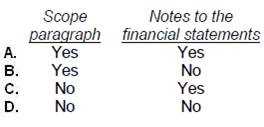
- A. Option A
- B. Option B
- C. Option C
- D. Option D
Answer:
B
Explanation:
Choice "b" is correct. When a qualified opinion is issued due to a lack of sufficient audit evidence, the
lack of evidence should be disclosed in an explanatory paragraph before the opinion paragraph.
Since insufficient evidence is a scope limitation, the scope paragraph should also be modified to refer
to the limitation and to the explanatory paragraph that discusses it.
Choices "a" and "c" are incorrect. Management (and not the auditor) prepares the notes to the
financial statements. The auditor therefore would not refer to this (or any other) situation in the
notes to the financial statements.
Choice "d" is incorrect. The auditor does refer to the situation in the scope paragraph.
Question 14
When an auditor believes there is substantial doubt about the ability of an entity to continue as a
going concern, all of the following should be included in the audit documentation, except:
- A. The conditions that gave rise to the substantial doubt.
- B. The auditor's conclusion about whether substantial doubt remains or is alleviated.
- C. Management's conclusion regarding whether substantial doubt remains or is alleviated.
- D. The effect of the auditor's conclusion on the auditor's report.
Answer:
C
Explanation:
Choice "c" is correct. Whether substantial doubt remains or is alleviated is a judgment call made by
the auditor, and there is no requirement to document management's opinion on the matter.
Choices "a", "b", and "d" are incorrect. When an auditor believes there is substantial doubt about the
ability of an entity to continue as a going concern, the conditions that gave rise to the substantial
doubt, the auditor's conclusion about whether substantial doubt remains or is alleviated, and the
effect of the auditor's conclusion on the auditor's report should all be documented.
Question 15
After considering an entity's negative trends and financial difficulties, an auditor has substantial
doubt about the entity's ability to continue as a going concern. The auditor's considerations relating
to management's plans for dealing with the adverse effects of these conditions most likely would
include management's plans to:
- A. Increase current dividend distributions.
- B. Reduce existing lines of credit.
- C. Increase ownership equity.
- D. Purchase assets formerly leased.
Answer:
C
Explanation:
Choice "c" is correct. The auditor considers any of management's plans that might serve to mitigate
the adverse effects of particular conditions and events. Typically, plans to increase ownership equity,
to borrow money, to restructure debt, to sell assets, and/or to reduce or delay expenditures might all
be considered mitigating factors.
Choices "a", "b", and "d" are incorrect. Increasing dividend distributions, reducing lines of credit, and
purchasing assets would not improve a weak cash flow situation.